Three Knights are in a hurry. One rears his horse, one gallops with a sword, one rides forward holding out a cup. The fourth has stopped. He sits a heavy farm horse in the middle of a ploughed field, holds a single gold coin up at eye level, and looks at it. No charge, no flourish, no destination on the horizon. The Knight of Pentacles meaning starts with that one strange fact: he is the only Knight in the deck who isn't going anywhere — and the picture wants you to understand that on purpose.
Most guides log the detail and move straight on to "slow but steady." They notice the still horse the way you notice a typo, then keep reading. The stillness is the whole card. Everything else grows out of it.
Quick Answer
Upright, the Knight of Pentacles means reliability, diligence, routine, and slow steady progress — the patient grind that finishes what it starts. He represents methodical effort, responsibility, and doing the unglamorous work that actually produces results. Reversed, that steadiness sours into stagnation, boredom, stubbornness, perfectionism, or being stuck in a rut. As a Yes/No card he is a slow yes: the answer is favorable, but it arrives at a walking pace, not a gallop.
Basic Information
| Card Name | Knight of Pentacles |
| Suit | Pentacles |
| Arcana | Minor Arcana |
| Element | Earth |
| Astrological Correspondence | The fiery air of Earth (Virgo, with a Capricorn–Taurus span) |
| Yes / No | Yes (slowly) |
| Upright Keywords | reliability, routine, diligence, method, responsibility, slow steady progress |
| Reversed Keywords | stagnation, boredom, stubbornness, perfectionism, stuck in a rut |
Card Imagery & Symbolism
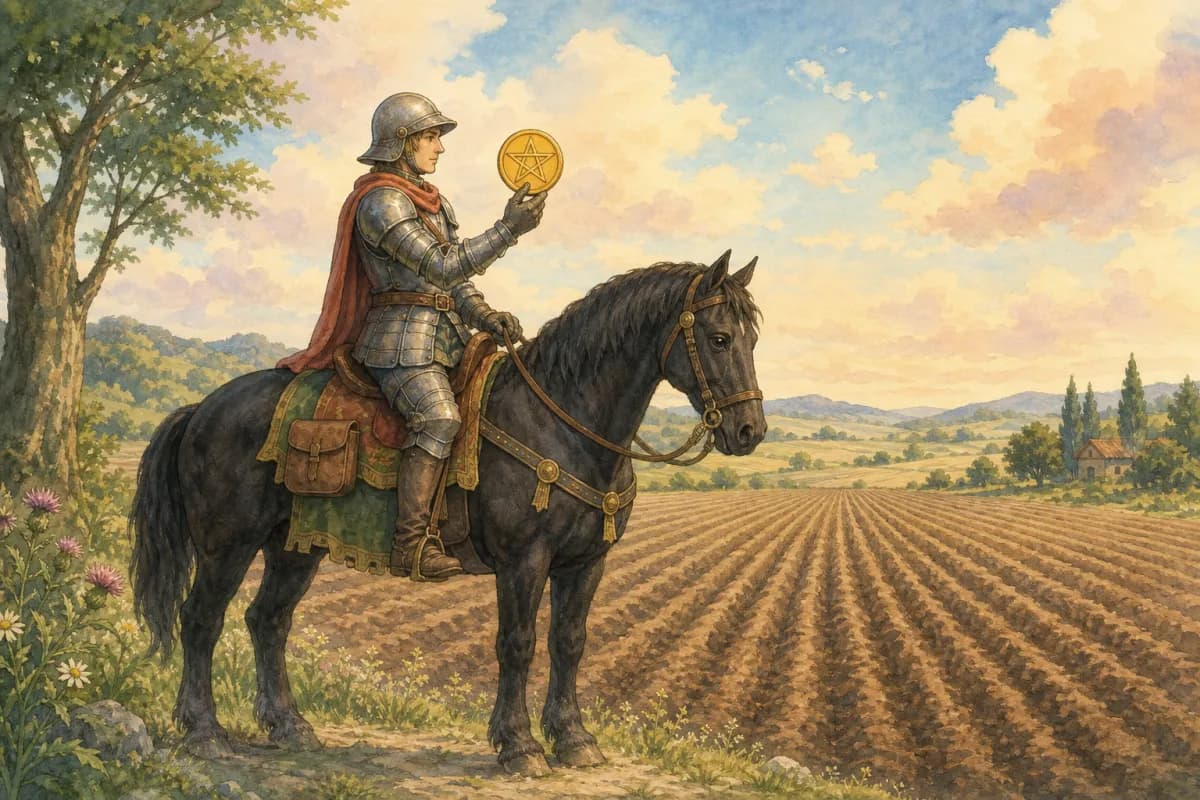
Pull up the Rider-Waite-Smith image. The composition is almost aggressively calm: a knight in armor, a dark horse, a stretch of farmland, a coin held level. Every court card in the suit carries the same dignity, and this one wears it as deliberate stillness. The drama is hiding in three details the popular guides skim.
The Horse Has Stopped Dead — and It's a Plough Horse
The other three Knights ride animals built for war and motion. This horse is heavier, calmer, the kind bred to pull a plough through wet soil all day. Pamela Colman Smith gave him a workhorse where the others got a charger, and then she stopped it completely. All four hooves are on the ground. Nothing about the posture suggests the horse is about to move.
That is the choice nobody dwells on. A still horse in a deck full of motion is a deliberate statement that the energy of this card is being held in reserve. The power is there, harnessed, idling at full strength. He has the means to move and has chosen, for now, to stay put.
The Field Behind Him Is Already Ploughed
Look past the horse. The furrows in the field are neat, parallel, finished. The Page of Pentacles gets the wild land and the green meadow of pure potential; the Knight stands on ground that has already been worked. Row by row, somebody walked that ground and turned it over, and the rows are even because careful, unhurried hands made them that way.
I find this the most honest detail in the card. The ploughed field is the visual receipt for everything the Knight stands for: the result you are looking at was produced by dull, repeated motion, the same action performed until the field was done. The card shows you the output of patience and quietly declines to show you the boredom that made it.
The Coin Is Held Level and Studied
He holds the pentacle up and looks at it. The Page presents his coin and offers it forward; this Knight keeps his and weighs it. The gesture is appraisal — turning the thing over, deciding what it is worth and what to do next before he commits to anything at all.
That level, steady hold tells you how this Knight makes decisions. He measures first. The coin does not wobble, does not slip. Whatever he commits to, he will have looked at it long enough to be sure, which is why he is so reliable once he moves and so maddening before he does.
Knight of Pentacles Upright Meaning
Core keywords: reliability, diligence, routine, method, responsibility, slow steady progress.
Upright, this card is the deck's portrait of the person who finishes things — quietly, at their own unhurried pace, all the way to done. When the Knight of Pentacles turns up, the work in front of you gets done by showing up to it again and again until it is finished — the report filed on time, the savings built one paycheck at a time, the skill drilled until it stops being hard. He is consistency made into a figure.
What separates him from the other Knights is the quality of the energy. The Knight of Wands wants to start, the Knight of Swords wants to win the argument, the Knight of Cups wants to feel something. The Knight of Pentacles wants to complete. He is at home in the part of any project everyone else finds tedious: the middle, the maintenance, the hundredth repetition. That tolerance for the dull stretch is his entire value.
The card also carries responsibility in a plain, almost old-fashioned sense. He keeps his word. He does the chore nobody volunteered for. If he tells you he will handle it, it is handled, and you will not have to ask twice. In a reading this often means the situation is asking for that exact posture from you: steady follow-through, applied day after day.
There is one cost built into the gift, and it belongs here in the upright read, well before any reversal. This Knight is slow. Genuinely slow. He will not be rushed, and pushing him only makes him dig in. When he appears, the timeline is longer than you want and the progress is real anyway. Both of those things are true at once.
Knight of Pentacles Reversed Meaning
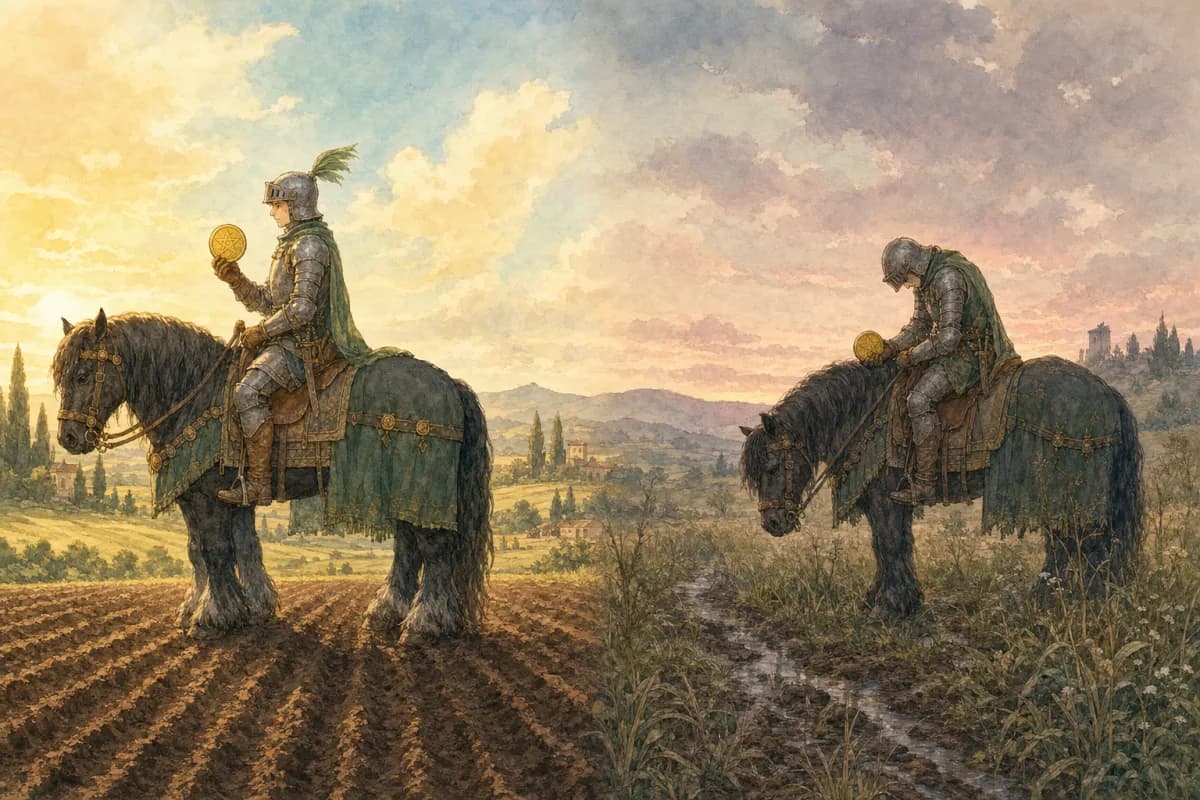
Reversed, this card stays quiet. Many readers brace for a dramatic disaster — a betrayal, a sudden loss — and then spend the reading waiting for a blow that simply walks past them. The reversal is harder to spot precisely because it is so subdued: it is what happens when a virtue keeps running after it has stopped being useful.
The most common face is stagnation. The steady progress has flatlined. He is still going through the same motions — same routine, same effort, same plodding pace — but the motions stopped producing anything a while ago, and nobody noticed because the routine looked exactly the same on the day it was working and the day it wasn't. The plough keeps moving over ground that has already been turned.
Then there is the boredom and the rut: the daily grind hardened into a cage, the same week repeated until the person inside it has gone numb. The card can point to a job, a project, or a habit that should have ended or evolved but didn't, kept alive purely by inertia.
The sharper reversed reads cluster around control. There is stubbornness — refusing to adapt, insisting on the old method long after conditions changed, mistaking rigidity for reliability. And there is perfectionism, the Knight's care turned compulsive, where the work never ships because it is never quite good enough, and "thorough" becomes the excuse that hides the fear of finishing. Underneath every version is the same misfire: the patience that should be building has stopped building and started merely idling, burning effort without moving forward.
When I see this card reversed, the diagnostic question is simple. Is the slowness still serving something, or has it become the point?
The only motionless knight in the deck — why slow is the entire point?
Every guide notes that he's the one Knight standing still. Almost none of them ask why the deck would bother to draw a Knight — a figure that exists to depict motion and momentum — and then freeze him. That is a strange thing to do, and strange things in tarot are usually the message.
Here is the reading the popular pages skip. The other three Knights each capture a moment: the spark of starting, the rush of the charge, the gesture of the approach. They are snapshots of energy in flight. The Knight of Pentacles cannot be a moment, because the thing he represents only exists across many of them. Diligence is invisible in a snapshot. Showing up once looks identical to showing up every day; the difference surfaces only over time. So Smith painted a quality that lives in repetition the only way she could — she stopped time entirely and pointed at the field behind him.
That ploughed field is the trick. You cannot draw "he worked patiently for months," so the card shows the result of the patience and lets the still horse tell you the method. The stillness here is itself a form of action, compressed into a single state — all of those identical, boring, repeated steps collapsed into one image of a man who has clearly been doing this for a long time and intends to keep doing it.
This is why "slow but steady" undersells the card so badly. The slowness is the engine that produces the reliability. It does the actual work; everything else the card promises rides on top of it. The results in that field came from the willingness to perform the same dull motion long past the point where a faster temperament would have quit or chased something more exciting. Take the slowness away and you do not get a faster Knight of Pentacles. You get one of the other three, and you get their unfinished projects.
A client in Shibuya once pulled this card about a certification she had been studying for at a crawl, fitting an hour of review around a full-time job, and she read it as the deck scolding her for not going faster. It was the opposite. The card was confirming that the crawl was the correct speed — that the hour-a-day grind she found so unimpressive was exactly the engine that finishes a thing that big. She wanted permission to sprint. The Knight of Pentacles does not grant that permission, because sprinting is how a certification that size collapses half-finished. The slow crawl was never her problem. It was her plan, quietly working.
So the answer to why he stands still: because the deck needed one card to honor the unglamorous truth that most real things get built by boring, repeated effort, and you cannot honor that with a card that moves.
Career & Work
This is the Knight of Pentacles' home ground, and in a work spread he is usually good news with a tempo attached. He points to steady employment, dependable progress, a project that will get finished if you keep grinding at it. He is the colleague who is never flashy and never lets you down, the slow promotion earned by being the one who actually delivers.
The practical advice is almost always about pace and persistence. This card rewards the person who keeps a schedule and works the plan over the person waiting for a brilliant shortcut. If you have been doubting a slow path — a degree finished part-time, a business built without funding, a craft practiced for years before it paid — the Knight of Pentacles is the deck telling you the path is sound and the speed is fine.
Reversed in career, watch for the rut. The reliable employee can become the stuck one, doing the same job long after it stopped teaching them anything, too cautious to chase the thing they actually want. Here the card flips its own advice: the steadiness that served you may now be the comfortable trap keeping you in place.
Money & Building
In a finances spread this Knight is one of the most reassuring cards in the deck, and one of the least exciting. He is the slow accumulation of security: budgeting, saving, paying down debt one installment at a time, the financial habits that are boring precisely because they work. Expect no windfall and no gamble. What he offers is the methodical building of something solid that will still be standing in ten years.
The shadow side is hoarding the method past its usefulness — being so committed to caution that you never invest, never spend on the thing that would actually improve your life, treating "responsible" as a reason to never move. Steadiness is the gift; the failure comes when it freezes solid.
Personal Energy & Routine
Stripped of any specific question, the Knight of Pentacles reads as a call to ground yourself in routine. It shows up for people who have been scattered, over-extended, or chasing too many things at once, and it prescribes the dull cure: pick one thing, build a structure around it, and do it daily. The card is a steadying hand on the shoulder, the deck noticing that what you need right now is consistency, plain and daily.
The reversed warning mirrors the work read. Routine is medicine in the right dose and a slow poison past it. When the structure that was holding you together starts dulling you out instead, the Knight reversed is asking you to look hard at the routine and notice whether it has quietly hardened into a rut.
Knight of Pentacles Card Combinations
- Knight of Pentacles + Eight of Pentacles — the apprenticeship card meets the diligence card, and the pairing is almost redundant in the best way. This is deep, focused skill-building: putting in the unglamorous reps until mastery is real. If it shows up around study, training, or a craft, it is the clearest "keep grinding, it's working" signal the deck offers.
- Knight of Pentacles + The Tower — careful, slow building next to sudden collapse. Read this as a warning that the methodical structure you have been patiently constructing may be sitting on an unstable foundation, or that an unexpected shake-up is about to test how solid your slow work actually is. Sometimes it means the rut you're stuck in is about to be broken for you.
- Knight of Pentacles + The Star — patient effort meets quiet hope. A gentle, encouraging pairing: the long, slow grind is heading somewhere worth reaching, and the Star says the faith required to keep at it is justified. Good to see when you are tired of how long something is taking.
- Knight of Pentacles + Eight of Cups — steady commitment beside the urge to walk away. This is the moment of asking whether your patient persistence has become genuine devotion or just inertia you're afraid to leave. The combination forces the rut question: are you still building, or are you staying because staying is easier than going?
- Knight of Pentacles + Knight of Wands — the two opposite tempos of the deck in one spread. Earth's patience against fire's impatience: one finishes, one ignites. Often a sign you need to borrow from the other Knight — either the Wands fire to break out of a rut, or the Pentacles discipline to finish what the fire started.
- Knight of Pentacles + Seven of Pentacles — a double-Earth pairing on the same wavelength. Both cards run on the same slow, marathon pace and the refusal of shortcuts: the Knight does the daily grind, the Seven steps back to let it ripen. Together they're the deck confirming there's no faster way through — only patient effort and the wait that lets it pay off.
- Knight of Pentacles reversed + Four of Pentacles — stagnation meets clinging. A heavy pairing for being stuck: stalled in place and gripping the safe, familiar thing so tightly there is no room to grow. The deck pointing squarely at fear dressed up as prudence.
Numerology & Astrological Correspondences
As a court card, the Knight sits between the Page (the student) and the King (the master) — the suit's energy in active service, the apprentice who has learned the method and is now grinding it out in the world. In the Golden Dawn system he carries the fiery air of Earth and answers to Virgo, the careful, detail-minded sign that gives his diligence its precise, methodical quality, with his reach spanning the earthy ground from Capricorn into Taurus. In Japanese tarot reading the word my teacher always reached for is 「地道」(jimichi) — steady, honest, unflashy effort sustained over time, the quiet dignity of plodding work done well. It is a compliment with no glamour in it, and it names this Knight exactly.
Frequently Asked Questions
What does the Knight of Pentacles mean in tarot?
It means reliability, diligence, and slow steady progress — the patient, methodical effort that finishes what it starts. He is the deck's figure of consistency: showing up, doing the unglamorous work, and building real results one repetition at a time. Upright he confirms a slow path is sound; reversed he warns the steadiness has gone stale into stagnation, boredom, or a rut.
Is the Knight of Pentacles a yes or no card?
It is a slow yes. The answer leans favorable — the thing you are asking about can work — but it arrives at a walking pace, on a timeline measured in weeks and months. Read it as "yes, if you are willing to be patient and put in steady effort." Just don't expect it fast or effortless. If the question demands speed, the qualified pace is the catch worth noting.
Why is the Knight of Pentacles the only one standing still?
Because diligence cannot be drawn as a moment. The other Knights capture an instant of motion; this card represents a quality that only exists over time, through repetition. Smith stopped the horse and painted the already-ploughed field behind him so the stillness could stand in for months of patient, repeated work. Read the slowness as the message itself.
What does the Knight of Pentacles mean in love?
It points to a slow, steady, dependable connection built on consistency and follow-through — the kind of love that shows up in small reliable acts, loyal and serious about the long term, and in no hurry. Reversed, it can mean a relationship gone stale or stuck in a rut. For the full relationship reading of how this energy actually feels, see our companion guide on the Knight of Pentacles as feelings.
Is the Knight of Pentacles reversed always negative?
No. It usually signals stagnation, boredom, stubbornness, or perfectionism — a virtue that has overstayed its usefulness, with disaster rarely entering the picture. The reliable effort has stopped producing and started idling. The usual fix keeps the steadiness in place and adds one diagnostic step: look honestly at whether the slowness is still building anything, and treat a flat answer as a sign you've drifted into a rut.
What kind of person is the Knight of Pentacles?
Reliable, hardworking, loyal, patient, and a little stubborn. He values stability and routine, keeps his word, and finishes what he starts, but he won't be rushed and rarely chases the spotlight. Think of the dependable colleague or partner who is never flashy and never lets you down — steady to a fault, with the rut as his risk.
How is the Knight of Pentacles different from the King of Pentacles?
The Knight is the method in motion — still learning, still grinding, the apprentice who has the discipline but not yet the mastery. The King of Pentacles is the same earth energy after the foundation is finished: the established master who has already built his wealth and stability. The Knight is doing the slow work; the King is the result of having done it for years. The Queen of Pentacles is the same earth energy turned nurturing and practical — where the Knight grinds out the task, she runs the warm, resourceful home around it.
Closing
Next time this card turns up, resist the urge to read the slowness as a problem to fix. Find the one thing you have been grinding at and quietly doubting — the slow study, the small savings, the skill that won't speed up — and give it one more unglamorous session today, at exactly the pace it's been going. The field gets ploughed one boring row at a time. The Knight never gallops, and that steady walk is exactly what carries the work all the way to a finished field.
See how this same earth-court patience reads in matters of the heart in Knight of Pentacles as feelings, or follow the suit forward to its master in the King of Pentacles as feelings.