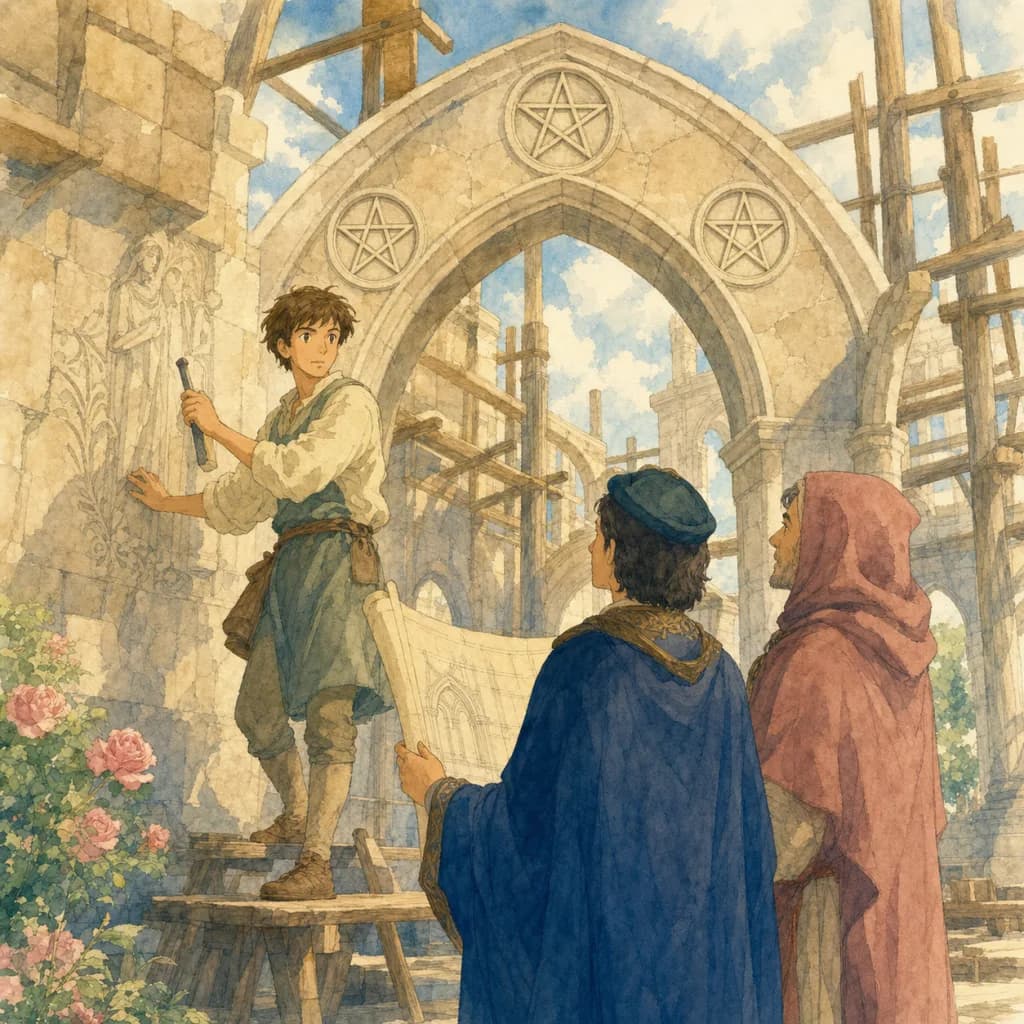
Three people stand inside a half-built cathedral. A young sculptor balances on a bench with his chisel still in hand, turned to face two figures who have come to look at the work. One of them holds a sheet of plans. They are talking. That is the whole scene. The usual one-word summary is "teamwork," yet the staging is making a sharper point: the worker has stopped working to have the conversation, and nobody in the frame is pretending to be the only one who knows what they are doing.
The Three of Pentacles is the card of skilled people in a room together, the moment the solo grind turns into something built with other hands. "Collaboration is good" undersells it. The picture is doing something more specific than that.
Quick Answer
Upright, the Three of Pentacles means teamwork, skilled collaboration, and recognition of good work — a project moving forward because the right people are pooling their expertise and listening to each other. Reversed, that coordination breaks down: misaligned goals, ignored expertise, sloppy effort, or a workplace where your skill goes unseen. As a Yes/No card it is a soft yes, conditional on whether you are willing to work with others rather than alone.
Basic Information
| Card Name | Three of Pentacles |
| Suit | Pentacles |
| Arcana | Minor Arcana |
| Element | Earth |
| Astrological Correspondence | Mars in Capricorn |
| Yes / No | Yes (conditional on collaboration) |
| Upright Keywords | teamwork, collaboration, skill, building mastery, recognition of work |
| Reversed Keywords | lack of teamwork, misaligned goals, mediocrity, ignored expertise |
Card Imagery & Symbolism
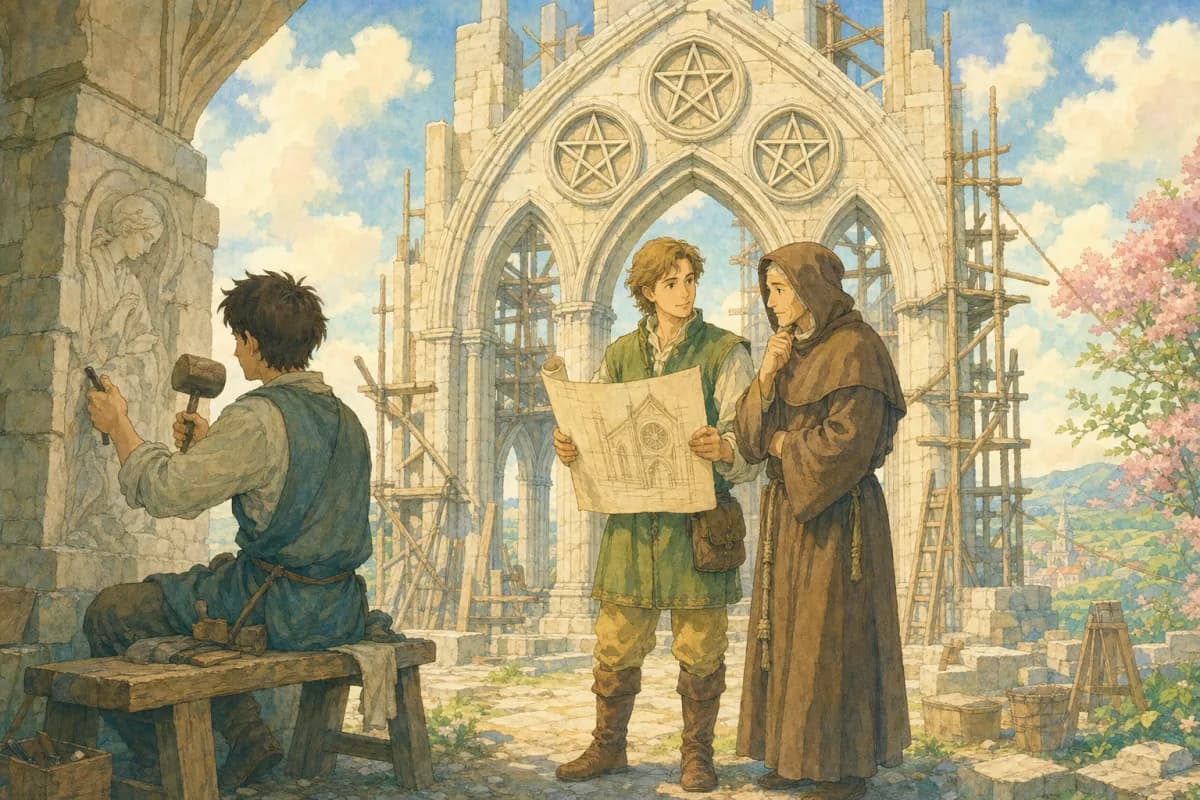
Pull up the Rider-Waite-Smith image and you see a scene that looks almost mundane next to the other Pentacles cards. No coins raining from clouds, no garden, no beggars in the snow. Just three people and an unfinished wall. The drama is in the staging, and Pamela Colman Smith staged it carefully.
The Sculptor Has Turned Away From the Work
The young man on the bench is mid-job — chisel in one hand, mallet implied — but he is not striking the stone. He has rotated his body to face the other two. Reach for "hard work" and you miss this detail. What the card shows is the pause inside the work, the moment a craftsman lifts his head to check his understanding against someone else's. The labor is real, and Smith froze the interruption rather than the chiseling. Building mastery, in this card, includes knowing when to stop and talk.
The Plans Are in the Patron's Hands, Not the Worker's
One of the two standing figures holds a sheet of plans. The sculptor does not have them. He has the skill and the tools; someone else holds the design. This split is the quiet engine of the whole card. Knowledge is divided here — the person who can read the drawing cannot carve the stone, and the person who can carve the stone is working from someone else's drawing. Neither one is complete alone. I will come back to who is holding what, because it is the part nobody reads closely enough.
The Cathedral Is Unfinished On Purpose
The arch above them is built but the structure is plainly mid-construction, and the bare scaffolding is the whole point of the staging. A cathedral is the medieval example of work no single person lives to see completed. The mason who lays the foundation often dies before the spire goes up. By setting the meeting inside an unfinished cathedral, the card frames collaboration as something that outlasts any one contributor. You are building a thing larger than your own stretch of it, and the card is calm about that. The reward here is the competence shown in this stage, witnessed by people who can tell good work from bad. Admiring a finished building comes much later, if at all.
Three of Pentacles Upright Meaning
Core keywords: teamwork, skilled collaboration, recognition, apprenticeship, building something with others.
Upright, the Three of Pentacles arrives when a project stops being yours alone and becomes a joint effort that actually works. The skills line up. The right people are in the room. Someone with the plans is talking to someone with the hands, and the conversation is productive instead of territorial. This is the card of the well-run team, the good mentorship, the moment your individual talent gets plugged into something it could not have reached by itself.
It is also a recognition card, and this is the half people forget. The sculptor is being watched by two people who came specifically to see the work. They are not micromanaging. They are evaluating, and the fact that they are there at all means the work is worth evaluating. When this card turns up, your effort is being noticed by people who can actually judge it. That is rarer and more valuable than applause from people who cannot tell the difference.
The Three of Pentacles rewards a specific posture: do your part excellently, then show it to people who know enough to push back. The lone genius gets nothing here. The card favors the skilled person who stays in the room and lets the work be tested.
What it asks in return is humility about scope. You are one set of hands on a cathedral.
Three of Pentacles Reversed Meaning
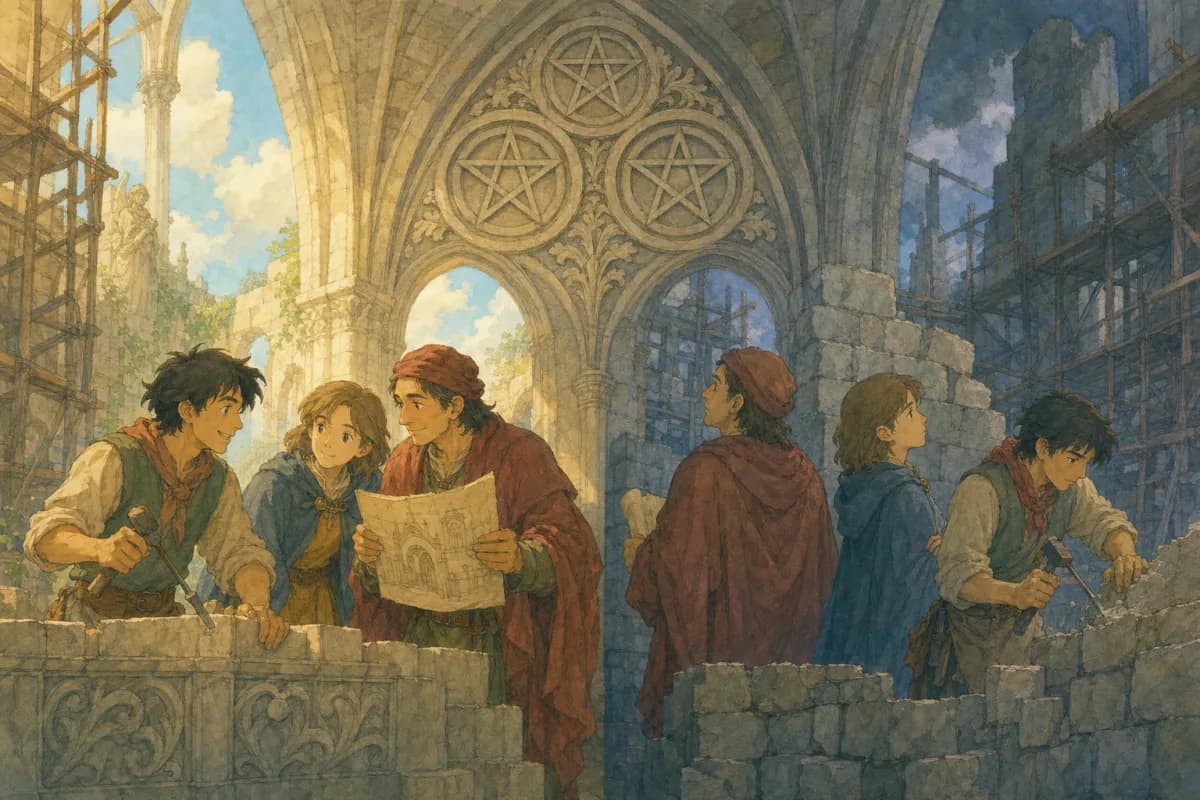
Reversed, this card rarely means catastrophe, and clients who reach for that reading get talked down from it. The project is seldom doomed. What has happened is that the thing making the upright card work — people fitting their skills together — has slipped out of alignment.
The most common reversed read is the team that has stopped functioning as one. People are pulling toward different goals, the plans and the hands have stopped talking, someone is building to a spec nobody agreed on. The cathedral is still going up, but crooked, because the three people in the frame have turned away from each other instead of toward.
A second flavor is ignored expertise. The sculptor is in the room, he knows something about how stone actually behaves, and the people with the plans are not asking him. His knowledge is present and wasted. I see this constantly in readings about work — a querent who is genuinely the most skilled person in their corner, sitting in meetings where nobody thinks to ask them anything.
A third is mediocrity creeping in. The standard has dropped. Good enough has become the ceiling instead of the floor. The pride that the upright card takes in craftsmanship has gone flat, and the work shows it.
Reversed, the question is always which of these you are in, because the fix differs. A misaligned team needs a hard conversation about goals. Ignored expertise needs you to speak up or leave. Mediocrity needs you to raise your own bar before you blame anyone else's.
Who is actually the expert in the room — and who gets asked?
Here is the part worth sitting with longer. The composition is usually described the same way: a young craftsman, two more senior figures, often read as a monk and a hooded patron or architect. The older figures "value his opinion" or "consult him despite his inexperience," and the description tends to end there. The picture is arguing about something more pointed.
Look again at the staging. The sculptor has the skill in his hands — he is the only one who can turn the design into stone. The patron holds the plans but cannot carve. The monk, by the usual reading, holds the spiritual purpose, the why of the building, and can neither draw nor carve. Three people, three completely different kinds of expertise, and Smith has drawn them meeting as equals. The young one stands at roughly the height of the seated elders, all three leaning toward the same wall as peers rather than as a junior reporting to his betters.
Now ask the question the keyword lists tend to skip: in your situation, who is actually the expert, and who is being treated as the expert? Those are not always the same person.
This is where the card earns its place in a real reading. The Three of Pentacles upright is the rare picture where the person with the practical skill gets pulled into the planning conversation. In most organizations, the people holding the plans rarely consult the person holding the chisel; they assume the design is the hard part and the execution is just labor. Here the carver is in the meeting and his opinion carries weight, because the people who can read a drawing know they cannot predict how the stone will split.
So when this card appears around a project, I read it as a diagnostic. If you are the sculptor — the one with the hands-on skill — the upright card says your input is wanted, speak up, you have been invited into the room for a reason. If you keep your head down and just carve, you waste the one thing the card is offering you. And if you are one of the figures with the plans, the card is asking whether you have actually consulted the person doing the work, or whether you are presenting them with decisions already made and calling it collaboration.
The reversed card is the same scene with the consultation removed. The carver carves, the planners plan, nobody crosses the gap. The expertise is all still present in the room, just never asked for. That is the specific failure the Three of Pentacles reversed describes, and it does more quiet damage than open conflict. There is no fight. The most knowledgeable person simply never gets the question.
Career & Work
This is the Three of Pentacles' home ground. In a career spread it is one of the most encouraging Minor Arcana cards you can pull, because it means your work is both good and seen. A project is coming together, the collaboration is functional, and people whose judgment matters are paying attention to what you produce.
For anyone learning a trade or early in a field, this card is apprenticeship in its best form — the stretch where a skilled beginner works alongside more experienced people and is treated as a contributor rather than a gofer. If you are studying, training, or building a portfolio, the card says the effort is compounding and the right people are noticing.
The practical advice is to stay collaborative on purpose. The Three of Pentacles rewards the person who shows the half-built version to people who can improve it, and it has nothing to offer the one who hides the work until it is flawless. Ask for the review. Take the meeting. Let your stone be looked at while it is still being carved.
A client I read for in Setagaya — a freelance illustrator who had spent two years working entirely alone — kept pulling this card about a studio collective she had been invited to join and kept declining. She was afraid the collaboration would dilute her style. The card was not telling her the collective was perfect. It was telling her that two years of carving in private had hit the ceiling of what solo work could teach her, and that the people inviting her in could actually read her drawings. She joined. Her work got sharper within months — her voice stayed intact, and someone finally pushed back on it.
Relationships
In a love reading the Three of Pentacles is quieter than the romance cards, and that quietness is the message. This is partnership as a building project — two people constructing a shared life through real cooperation, where chemistry is only the starting material. It shows up for couples who plan well together, who renovate the apartment, raise the kid, run the business, and find that the joint effort itself deepens the bond.
It is a wonderful card for a relationship in a practical phase. It is a flat one for someone hoping for fireworks, because the Three of Pentacles is about the satisfaction of building, not the thrill of falling. If the question is whether a new connection will be exciting, expect a measured answer. If the question is whether you and someone could build something durable together, the answer is yes, provided you both stay in the room and keep consulting each other.
For singles, it often points to connection forming through shared work — a class, a project, a collaboration — rather than across a crowded bar.
Three of Pentacles Card Combinations
- Three of Pentacles + Eight of Pentacles — the apprentice and the dedicated grind. This pairing reads as deep skill-building inside a supportive setting: you are putting in the solitary practice of the Eight and getting the collaborative recognition of the Three. A strong signal for anyone training toward mastery. The lonely hours pay off in a room that values them.
- Three of Pentacles + The Hierophant — both cards carry institutions, mentorship, and learning the established way. Together they point to formal apprenticeship, a structured program, or work inside a respected organization. Read it as: there is a right method here and a teacher worth learning it from, so resist the urge to freelance the process.
- Three of Pentacles + Ace of Wands — raw inspiration meets the team that can execute it. The spark from the Ace finally lands somewhere with the skilled hands to build it. This is the inventor who finds collaborators, the founder who finds a team. Excellent for launching something that needs more than one person.
- Three of Pentacles + Five of Pentacles — collaboration next to exclusion. I read this tension as a warning that someone is being left outside the cathedral. The Three is the team inside the warm building; the Five is the figure in the snow. Ask who on the project is not being included, or whether you are the one shut out of a group that should have your skills.
- Three of Pentacles + The Tower — careful collaborative building meets sudden collapse. This is the project that was constructed well but on a flawed foundation, or the team that gets blindsided by an external shock. Do not stop building over it. Do go check the structure under the beautiful work.
Numerology & Astrological Correspondences
In numerology the threes mark a first completion, the point where a beginning finally produces an actual output, which is why threes so often involve a group bringing something into being — where the solo juggle of the Two of Pentacles becomes shared work, more hands on the same wall. Astrologically the card carries Mars in Capricorn: Mars supplies drive and discipline, Capricorn supplies structure, ambition, and respect for craft, and the combination reads as effort applied skillfully and patiently over time. In my training I learned to read this card through the Japanese phrase 切磋琢磨 (sessa takuma) — the polishing of skill through working alongside others, literally "cutting and grinding" until everyone in the room gets sharper. That image of mutual sharpening is what the card actually depicts.
Frequently Asked Questions
Is the Three of Pentacles a good card?
Yes, upright it is one of the more reassuring Minor Arcana cards. It signals teamwork that functions, skill that is recognized, and a project moving forward with the right people involved. The main caution is that it asks you to collaborate rather than go it alone, so it is "good" specifically for the person willing to work with others.
What does the Three of Pentacles mean in a career reading?
It points to functional collaboration and recognized skill — a project coming together, a mentorship or apprenticeship paying off, or your work being noticed by people whose judgment matters. The practical advice is to show your work in progress and stay in the conversation rather than hiding until it is perfect.
Is the Three of Pentacles reversed always negative?
No. It usually means the collaboration has slipped out of alignment, not that the project is doomed. Read it as one of three things: a team pulling toward different goals, expertise that is being ignored, or standards that have dropped to mediocre. Each has a different fix, so identify which one you are facing.
What does the Three of Pentacles mean in love?
It reads as partnership as a building project — two people cooperating to construct a shared life, deepening trust through joint effort rather than pure romance. It is excellent for a practical, building phase of a relationship and flatter for someone hoping for fireworks. For singles it can mean love forming through shared work or a creative collaboration.
Is the Three of Pentacles a yes or no card?
It is a conditional yes. The condition is collaboration: yes, if you are willing to work with others and pool skills rather than insist on doing everything alone. When the question hinges on solo effort, the card's answer weakens considerably.
What zodiac sign and element is the Three of Pentacles?
Its element is Earth and its astrological correspondence is Mars in Capricorn. The Earth element grounds it in practical, material work, and the Mars-in-Capricorn pairing gives it disciplined ambition — drive aimed at building something lasting and well-crafted.
What does the Three of Pentacles tell me to do?
Show your work to people who can judge it well, and ask for their input before it is finished. Whether you are the skilled hands or the one holding the plans, the card asks you to cross the gap and consult the other side rather than work in isolation.
Closing
The next time this card turns up, find the half-built thing you have been carving in private and show it to one person whose judgment you actually respect — before it is done, while it can still change. The Three of Pentacles rewards the craftsman who keeps the door open and lets the work be seen mid-stroke. That is the whole invitation.
Keep reading the suit's arc with the Eight of Pentacles for where dedicated practice goes next, or step back to the team-building spark in the Ace of Wands.