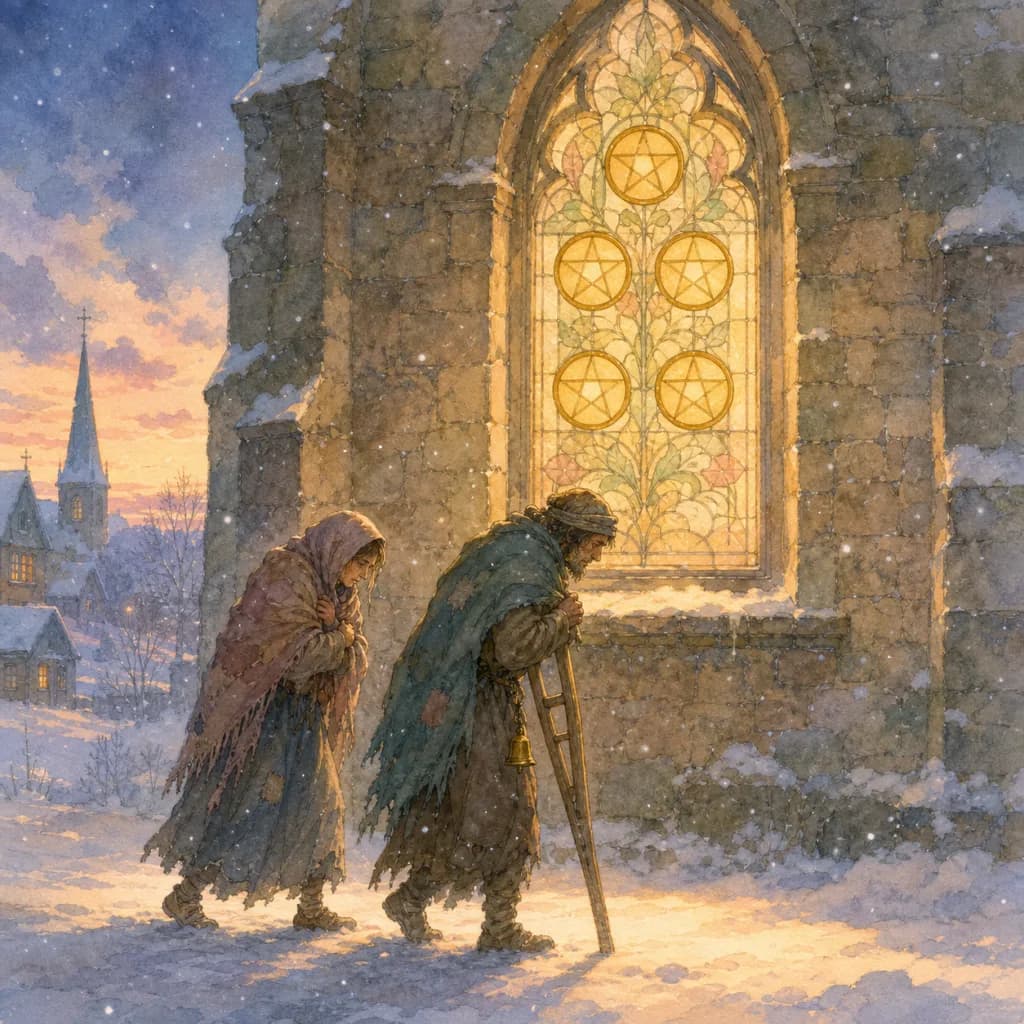
Two people drag themselves through deep snow. One is on crutches, a bell hung at his neck the way medieval lepers were marked so others could keep their distance. The other is barefoot, wrapped in a thin shawl, head down against the wind. They pass directly beneath a church window glowing with warm stained glass — and neither one looks up. That detail is the whole card. The Five of Pentacles meaning is usually summarized as poverty and hard times. That summary is accurate, yet it skips the part that actually hurts: the help is already lit, already close, already there. Nobody in the picture can see it.
Most guides will tell you to "ask for help." They are right. They just never explain why the figures can't.
Quick Answer
Upright, the Five of Pentacles means hardship, financial loss, insecurity, illness, and the cold feeling of being left out or shut out. Its deeper layer is a lack-mindset — being so fixed on what is missing that you cannot see the support standing right next to you. Reversed, the card turns toward recovery: the worst is passing, hope is coming back, and help is finally being noticed and accepted.
Basic Information
| Card Name | Five of Pentacles |
| Suit | Pentacles |
| Arcana | Minor Arcana |
| Element | Earth |
| Astrological Correspondence | Mercury in Taurus |
| Yes / No | No |
| Upright Keywords | hardship, poverty, insecurity, isolation, loss, left out in the cold |
| Reversed Keywords | recovery, hope returning, end of hardship, help accepted, stability rebuilding |
Card Imagery & Symbolism
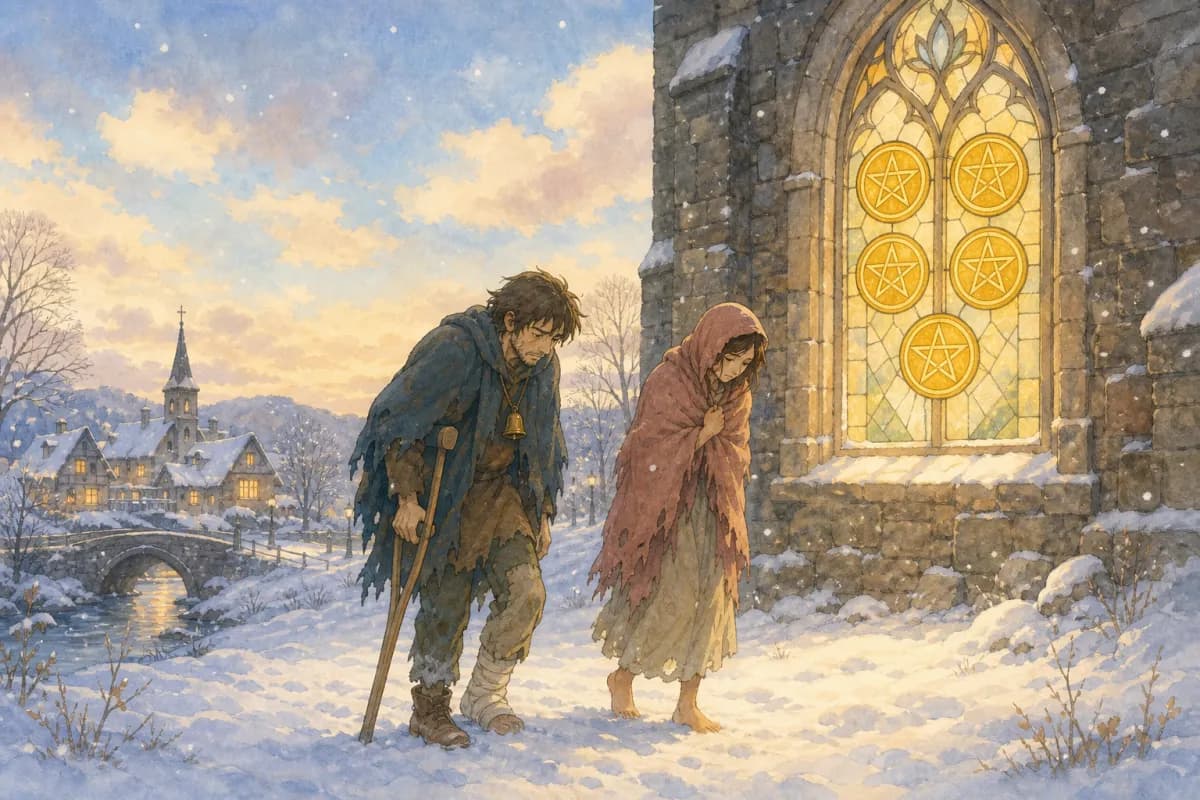
Pull up the Rider-Waite-Smith image and the first thing you register is cold. Most of the deck is warm-toned; this card is grey and white, snow falling in a flat black sky. Pamela Colman Smith painted very few true winter scenes, and she used the season here deliberately — this is the suit of Earth, of money and body and material life, drawn at the moment all of that fails. The richer material is in three details the popular guides walk straight past.
The Bell at His Neck Marks Him as an Outcast
Look at the figure on crutches. Around his neck hangs a small bell. In medieval Europe, lepers were required to wear a bell or clapper so the healthy could hear them coming and step away. Smith drew a man society has formally pushed outside its walls. The bell makes him a specific outcast, marked and avoided. This is why the Five of Pentacles carries so much more than empty pockets. It holds the specific sting of exclusion, of being the person others have agreed not to stand too close to. When this card describes financial trouble, it tends to be the kind that comes with shame attached, the kind you hide.
The Window Is Lit, and It Is Above Them
The stained-glass window glows gold and is loaded with detail — in some printings you can count five pentacles worked into the design, echoing the card's number, marking the building as a place of literal and spiritual wealth. It is warm, it is occupied, it is steps away. And it sits above the two figures, behind them as they trudge forward. The composition is exact: salvation sits right there in the frame, slightly overhead, pouring light onto the snow they are walking through. The card makes the proximity almost cruel on purpose. I will come back to this window, because it is the entire reason the card stings the way it does.
Neither One Looks Up
This is the detail that separates a good reading from a textbook one. The figures have stopped searching entirely. Their heads are bowed, their eyes on the snow, locked into the forward trudge of survival. The help is not absent. The attention is. Smith froze the precise instant where the answer is overhead and the people who need it are too deep in their own cold to lift their chins. That gap — between what is available and what is perceived — is what the Five of Pentacles is really drawing.
Five of Pentacles Upright Meaning
Core keywords: hardship, loss, insecurity, isolation, poverty, feeling left out in the cold.
Upright, this card lands during a genuinely hard stretch. Money is tight or gone — a job lost, a debt that will not shrink, a medical bill, a run of bad luck that has stopped feeling like luck and started feeling like a condition. The card is honest about that. It does not pretend the snow isn't real.
The bank balance is only half of it, though. The bell, the snow, the bowed heads all point to the emotional weather around the hardship: isolation, shame, the sense of having been left outside while everyone else is warm. Clients often describe it as feeling like an outsider — cut off from a group they used to belong to, or quietly convinced they are the only one struggling while everyone around them is fine.
There is a mindset reading layered underneath, and it is the one I trust most. The Five of Pentacles often shows up as a lack-mentality: a mind so trained on scarcity that it filters out everything except the threat. You count what is missing so compulsively that you stop registering what is present. This is the perceptual version of two people walking past a lit window without seeing it.
Read it as a snapshot of a passing state: cold, scared, looking down. The season lifts, and the card carries a quiet nudge to raise your head while you wait it out.
Five of Pentacles Reversed Meaning
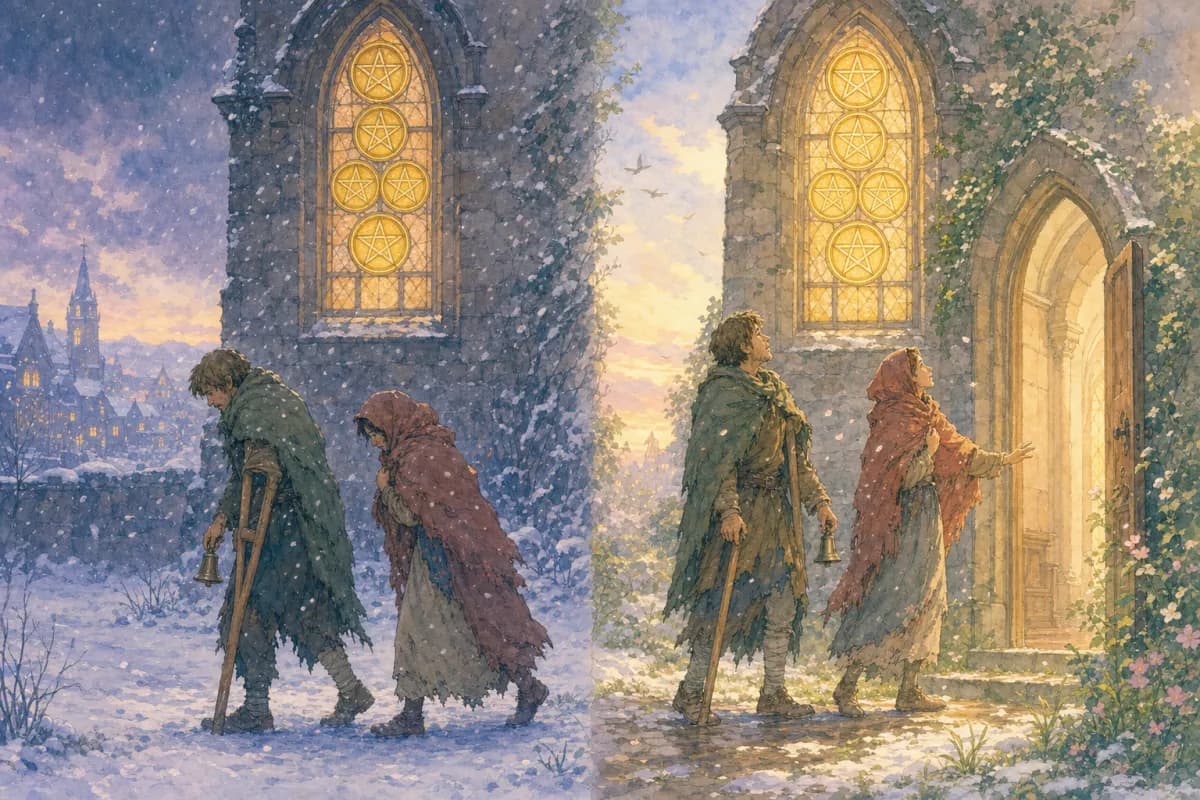
First, plainly: the reversed Five of Pentacles is one of the few reversals that usually reads more positive than its upright. I tell clients this immediately, because the upright is heavy enough that the reversal arriving feels like a held breath releasing.
Most commonly, reversed means the hard winter is ending. The worst has passed. Money starts to come back, health improves, a door reopens. It is rarely an overnight rescue — recovery in this card has a thaw's pace, slow and uneven — but the direction has turned. You are finally walking out of the snow, each step taking you toward warmer ground.
The reversal also frequently means the help is finally seen and taken. The figures look up. Someone offered support and this time you let yourself accept it, or you swallowed the pride and asked. That single shift — from enduring alone to allowing help in — is often the entire meaning of the card upside down.
There is a shadow version worth naming. Sometimes reversed points to a poverty of the spirit — an inner emptiness that money would not fix, a person surrounded by people and resources who still feels frozen out. If your material life has recovered but the cold has not lifted, that is the reading. The window always meant more than cash.
The lit window they never look at — when help is already within reach.
Here is the question almost every guide skips. They all mention the church window. They all say "help is available." But why, exactly, can the two people not see it?
Stand inside the card for a second. The help sits close, the door stands open, and nobody is being turned away. The light is pouring out over the snow they are physically walking through. By every external measure, rescue is solved. And it changes nothing, because the people who need it have their heads down.
Most guides flatten this into "be more proactive, just ask." That advice assumes the figures know the window is there and are choosing not to knock. The image says something harder. When you are deep enough in survival mode, your attention narrows to a tunnel — next step, next bill, next day. Scarcity empties your pockets and crops your field of vision in the same stroke. The lit window stays invisible because looking up is a thing a frightened, cold person genuinely cannot do until something breaks the trance.
I misread this card for the first three years I read professionally. I treated the window as the answer and the figures as foolish for ignoring it, and my readings came out faintly scolding — the help is right there, why won't you take it? A woman I read for in Setagaya, going through a brutal divorce and a layoff in the same season, stopped me mid-sentence and said, very quietly, that she knew her sister had offered to take her in. She knew. She could not make herself pick up the phone, and being told the phone was right there only made her feel more ashamed for not using it. That reading changed how I read this card permanently.
So when the Five of Pentacles appears, the real work is to ask what is keeping the head down. Pointing at the window and saying "look" only adds to the shame. Usually it is one of three things: shame (asking for help means admitting I failed), pride (I should be able to handle this myself), or sheer exhaustion (I am too far into survival to lift my eyes). Name which one, and the window becomes reachable. The help already exists; the card simply asks you to do the smaller, harder thing — raise your chin.
That reframe turns the card from a slap into a hand on the shoulder. The light has been on the whole time, and the reading turns on what it takes to notice it.
Money, Work & Financial Security
This is the Five of Pentacles on its home ground. In a money or career spread it points to real material strain — job loss, mounting debt, a contract that fell through, the season where the numbers do not work no matter how you arrange them. It can flag old debts surfacing or a financial situation you have been avoiding looking at directly.
The practical read is plain: stop facing this alone in the dark. The card consistently shows up for people who are quietly drowning while presenting as fine — the freelancer not telling anyone the pipeline dried up, the person paying minimums on cards nobody knows about. The advice the image gives is structural: the resource you need (a frank talk with the bank, a friend who would lend, a benefit you qualify for and never claimed) often already exists. What jams it up is the looking-down — the supply is there waiting.
One thing I push back on: people read this card as a sign they are bad with money or being punished, and that is a misread. Hard winters land on careful, diligent people all the time — the figures are in the snow because life dealt them a brutal season, full stop. Treating it as moral failure keeps the head bowed, which is the one thing this card is begging you to undo.
Health & the Body
Because Pentacles is the suit of the physical, the Five often reads as the body under strain — illness, depletion, the run-down state that comes after a long period of stress or financial worry. The man on crutches is a literal injury, and sometimes the card means exactly that: something in the body needs care and is not getting it.
The isolation theme matters here too. People who are unwell or in chronic pain often withdraw, convinced they are a burden, and the Five of Pentacles describes that withdrawal precisely. If the card lands in a health context, the reading frequently includes: do not go through this without support, even when isolating feels easier than explaining.
Spirit & Belonging
The lit building is a church, and that is not incidental. The Five of Pentacles often touches something beyond the material — a crisis of faith, a feeling of being spiritually out in the cold, cut off from meaning or community. Someone can have a full bank account and still be the figure in the snow if they have lost their sense of belonging to anything.
When the card appears in this register, it is asking about your relationship to community and meaning. Money has nothing to do with it. The warmth in the window is companionship and faith as much as it is shelter. Walking past it is walking past the people and the sense of purpose that would actually thaw you.
Five of Pentacles Card Combinations
- Five of Pentacles + Ten of Pentacles — the full arc of the suit's material story, from shut-out to settled abundance. Side by side, this often reads as a hard season that resolves into lasting security, or a reminder that the family wealth and warmth of the Ten is exactly what the figures in the snow are walking past. The thaw is coming, or it is right there.
- Five of Pentacles + The Tower — the loss has a sudden, structural cause. A layoff, a collapse, a partnership that broke without warning. This pairing reads as hardship that arrived all at once, and it calls for emergency support to steady the ground fast.
- Five of Pentacles + The Hierophant — the lit window made literal. The Hierophant is institution, church, established help: counseling, a support program, a mentor, a community that exists to catch people. This combination almost shouts that formal help is available and underused.
- Five of Pentacles + Three of Cups — isolation sitting beside the friendship that would end it. I read this as the friends who would gladly help if they knew, and a querent who has not told them anything is wrong. The support is one honest conversation away.
- Five of Pentacles + Six of Pentacles — the next beat in the suit, where help finally moves. The Six is the hand that gives, the moment the figures stop walking and someone shares what they have. After the Five's cold, this pairing is the warmth arriving.
- Five of Pentacles reversed + The Star — recovery and hope reinforcing each other. The winter is ending and faith is returning at the same time. One of the gentler combinations in the deck: the worst is over, and you can believe it now.
Numerology & Astrological Correspondences
In the suit's arc, five is where the Four's hard-won comfort cracks open and the material plane takes a hit — the warm room gives way to the snow outside. The card carries Mercury in Taurus, Mercury's quick mind slowed and stubborned by Taurus's earthy fixity — anxious thinking that circles the same worry without moving, the mental loop of someone counting losses. In Japanese タロット占い (tarō uranai, tarot divination), I keep returning to the word 助け合い (tasukeai, mutual help) when this card appears — it names something the snowbound figures have forgotten, that warmth in winter is something people make for each other rather than wait to receive.
Frequently Asked Questions
Is the Five of Pentacles a yes or no card?
It is a no. The card describes hardship, scarcity, and being shut out, so as a straight yes/no answer it leans firmly negative. The important caveat: it points to a passing hard moment that will lift in time — and reversed, the "no" softens toward recovery.
What does the Five of Pentacles mean in love?
It is a difficult card in a love reading. It can mean a relationship going through a cold spell — emotional distance, financial stress straining the couple, or one person feeling left out and unsupported. Single, it can describe loneliness or a fear of being unwanted. The card asks whether you are facing relationship trouble alone when you do not have to.
What does the Five of Pentacles mean reversed?
Reversed, it usually turns positive: the hard times are ending, money and health start to recover, and help is finally accepted. It is the card of looking up at last. Occasionally it warns of a spiritual emptiness that material recovery alone will not fix.
Why is the Five of Pentacles about isolation, not just money?
Because of the bell on the man's neck — a medieval marker for outcasts — and the bowed, separate heads of the two figures. Smith drew exclusion into the image deliberately. The card is poverty with shame and loneliness attached, which is why it stings more than a simple "low funds" card would.
What does the church window symbolize in the Five of Pentacles?
It symbolizes help, warmth, faith, and support that is already present and within reach. The point of the image is that the figures never look up at it — the help is available, but the people who need it are too deep in survival mode to see it. It is the card's central lesson: the resource often exists; the looking-up is the hard part.
Is the Five of Pentacles always negative?
No. Upright it is genuinely difficult, yet it describes a passing season that lifts — fives disrupt for a while and then move on. Reversed it is one of the more hopeful reversals in the deck. Even upright, the lit window is a built-in promise that warmth exists nearby.
What should I do when I draw the Five of Pentacles?
Lift your head and name what is keeping it down — shame, pride, or exhaustion. Then reach for the one piece of support that already exists in your life: a phone call, an honest conversation, a program you qualify for. Help is almost always within reach here; the card just wants you to stop walking past it.
Closing
The next time this card turns up in your snow, don't read it as a verdict. Find the one window you have been walking past — the friend you haven't told, the help you haven't claimed, the call you keep not making — and make the small, ungraceful move toward it today. The light has been on the whole time. The Five of Pentacles is only asking you to look up.
Trace the suit's recovery in the Six of Pentacles, where the help finally changes hands, or see where the cold resolves in the Ten of Pentacles.