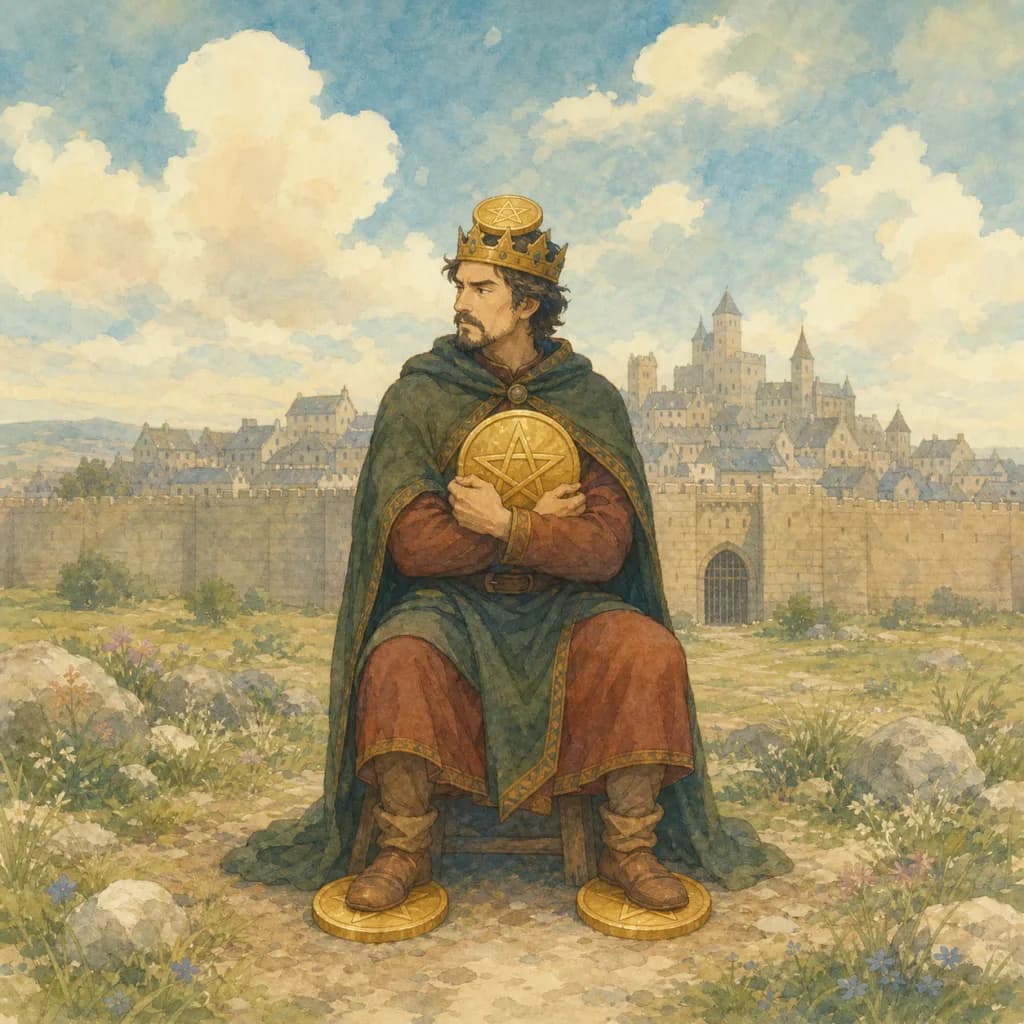
A man sits on a low stool just outside the gates of a city. He has one gold coin pressed flat against his chest, both arms locked around it. There is a coin balanced on top of his crown, and one pinned under each foot. Every limb he owns is busy holding money. And behind him, close enough to walk to, sits a whole city he never turns around to look at.
That last detail is the one almost every Four of Pentacles meaning skips. Most guides will tell you the card is about saving, security, holding on. They are right, and they stop too soon. Look again at the man himself: he has used up all four limbs guarding what he has, which leaves him no hand free for the city behind him.
Quick Answer
Upright, the Four of Pentacles means security, saving, and the instinct to hold tight to what you have — financial stability on the good days, a clenched scarcity grip on the bad ones. Reversed, it means loosening that grip: release, generosity, and letting go, or at the other extreme, the grip giving way into loss and financial insecurity. As a Yes/No card it leans no for anything that requires you to spend, share, or take a risk, because its whole posture is one of holding still.
Basic Information
| Card Name | Four of Pentacles |
| Suit | Pentacles |
| Arcana | Minor Arcana |
| Element | Earth |
| Astrological Correspondence | Sun in Capricorn |
| Yes / No | Leans No |
| Upright Keywords | security, saving, conservation, control, holding on, stability |
| Reversed Keywords | release, generosity, letting go, greed loosening, financial insecurity |
Card Imagery & Symbolism
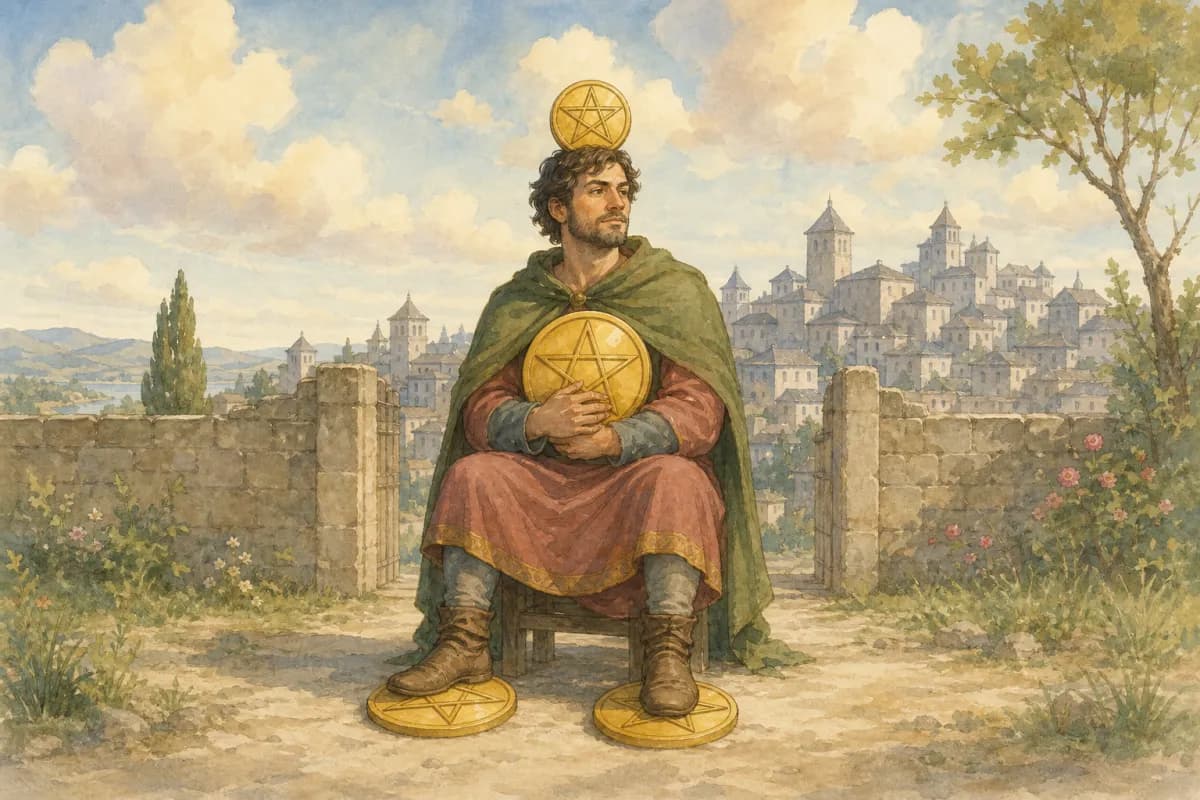
Pull up the Rider-Waite-Smith card and the first thing you notice is how busy the figure looks while doing nothing. He is seated, frozen, and yet every part of him is working. Pamela Colman Smith gave this man four coins and exactly enough body to hold four coins, and then placed him with his back to everything else in the frame. The composition is the argument.
The Coin Clutched to the Chest
His arms wrap a single pentacle against his heart, fingers laced over it. Nobody holds something they actually use this way. This is the grip of someone afraid of losing what he clutches. The coin sits over his chest, the place we instinctively cover when we feel threatened. What I notice, and what most guides tend to leave out, is that the chest coin is the one closest to his heart and the one he can see the least — he has it tucked so tight against himself that he would have to let go to even look at it. The thing he guards most carefully is the thing he can no longer really examine.
One Coin on the Crown, One Under Each Foot
The other three pentacles are deployed like a security system. One balances on top of his head, two are planted under his feet. Read it as a body map: the coin on the crown sits over his thoughts, the coins under his feet sit over his footing, his ability to move. Money is occupying his mind and pinning his stride at the same time. The detail people skip is the head coin's balance — it rests there precariously, perched rather than gripped, which means he cannot nod, cannot tilt, cannot look up without it sliding off. To keep the crown coin he has to hold his head perfectly still. Guarding wealth has cost him the freedom to move his own head.
The City That Sits Behind His Back
Over his shoulder, rendered small and grey, is a city. Buildings, walls, the whole settled world of other people. In Smith's visual grammar a city stands for community, commerce, the life that happens between people. And it is placed directly behind him, where he has chosen not to look. He sits outside the gates, on the threshold, neither in the city nor away from it. Most readings mention the city in one line, as proof he is "isolated." I read it as the heart of the card, and I will come back to it below, because the relationship between that man and that city is the whole question the Four of Pentacles is asking.
Four of Pentacles Upright Meaning
Core keywords: security, saving, conservation, control, holding on, stability.
Upright, this card describes the instinct to protect what you have built. On its good side that is real and worth honouring. You have something now — savings, a stable job, a roof, a relationship that works — and you are tending it carefully instead of gambling it away. After a lean stretch, the Four of Pentacles can be the deck noticing that you finally have a floor under your feet and are sensibly refusing to kick it out. There is nothing wrong with a man who keeps his coins. Capricorn, this card's astrological home, builds slowly and keeps what it builds.
The trouble starts when holding shades into clenching.
The same grip that protects can calcify. The card's shadow is the scarcity mindset: the conviction that there is never enough, that any coin spent is a coin lost forever, that loosening your hand even slightly invites disaster. In this state you stop spending money you have, decline opportunities that would cost you something upfront, and treat every request to share as a threat. The control extends past money. At work it becomes micromanaging, refusing to delegate, guarding your territory. In yourself it becomes rigidity, a flinch away from any change you did not plan.
The upright card rarely tells you which version you are living. That is the reading's job. The image is identical whether the man is prudent or paralysed — same coins, same grip. So the real upright question is diagnostic: is your holding-on keeping you safe, or keeping you stuck? The card hands you the posture and makes you check your own pulse.
Four of Pentacles Reversed Meaning
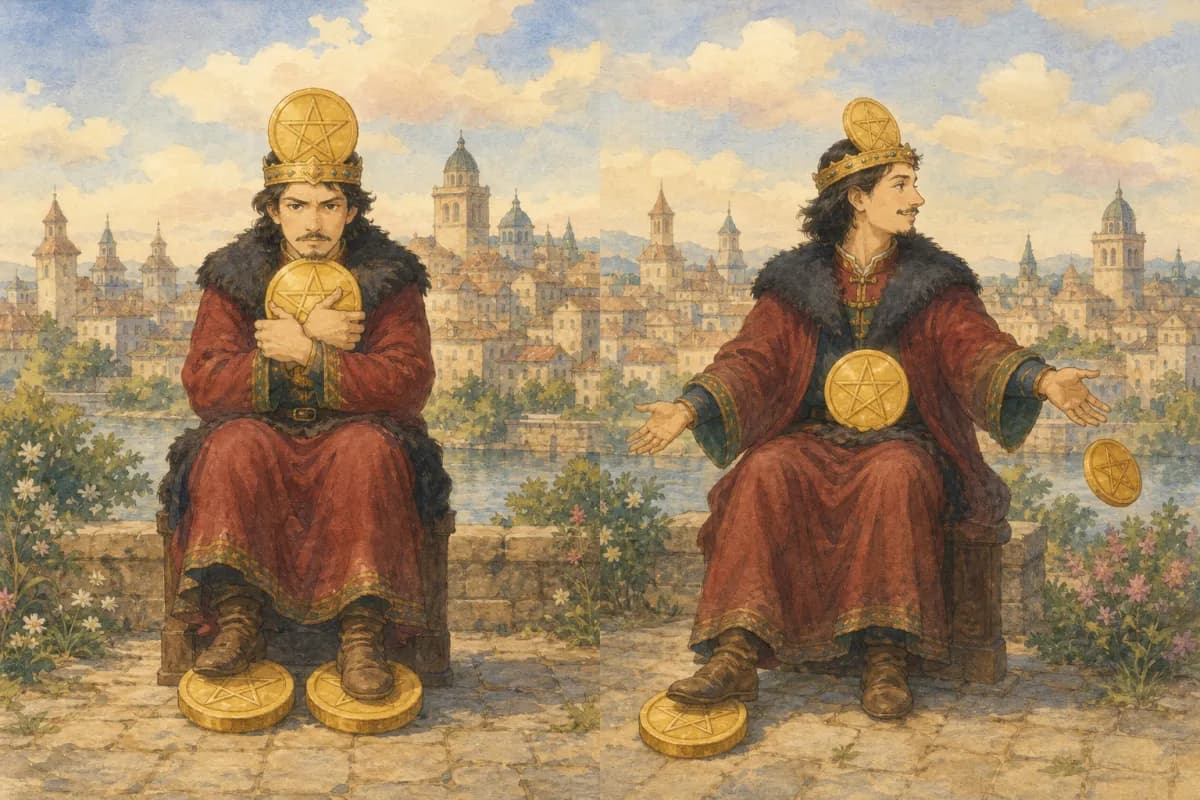
Reversed is not automatically the "good" version of this card, and I want to be clear about that up front, because a lot of people assume a tight card flipped over must mean liberation. Sometimes it does. Sometimes it means the floor gave out.
The most common reversed reading is release. The grip loosens. You feel ready to let go — of money you were hoarding, of control you were white-knuckling, of an old fear about not having enough. Generosity returns. You open your hand and discover the coins do not, in fact, vanish the moment you stop crushing them. After a long upright stretch this reversal can feel like exhaling.
But the reversal swings the other way just as easily, and you read which one from the cards around it. At the far end, the grip simply fails under its own strain. The held thing slips: money lost through a bad bet, theft, a sudden expense, reckless spending that overcorrects years of clenching in a single weekend. This is the financial insecurity end of the card — the man dropping all four coins at once because he could no longer sustain the effort of holding them.
There is a third, quieter reversed reading I see often: greed loosening just enough to be noticed. The person knows they have been gripping too tight, feels the first embarrassment about it, and has not yet acted. The card flipped is the awareness arriving before the change does. That is a hopeful place, but only if the awareness becomes a hand actually opening.
Is holding on protection, or the cage that locks the city out?
Go back to the city behind his back.
Every guide tells you this man is protecting his money. Almost none of them follow the geometry of the picture to its conclusion. He has four coins and four limbs, and each limb is assigned to a coin. His arms hold one. His feet pin two. His head balances the fourth. There is not a single part of him left over. So when the city behind him needs something from him — a handshake, a door held open, an arm around a friend — he has nothing free to offer. The defence is total, and a total defence is indistinguishable from a prison.
This is the part most guides gloss: the wall he built to keep the city out is the same wall that keeps him in. He is sitting on the threshold, gates at his back, and he cannot enter his own community because entering would mean putting a coin down, and putting a coin down is the one thing his whole body is arranged against. The wall that protects him is the same wall that holds him in place, and he does not get to keep one without the other.
I sat with this card wrong for the first few years I read professionally. I treated the city as backdrop — scenery to prove the man was lonely. Then a client in Setagaya, a man in his fifties who had paid off his house and lost every friend he had to overwork, drew it in the centre of a six-card spread, and I watched his face when I described the figure. He said, very quietly, that he had assumed the city would still be there whenever he was ready to turn around. That is the lie the card is built on. The city does not wait forever. The longer the man holds his perfect defensive posture, the more the city behind him goes about its life without him, until one day he turns and finds it has moved on.
So the answer to the question is: it is both, and that is exactly the problem. Holding on protects you right up until the moment it has gone on one beat too long, and then the same hold has quietly become the cage. The card will not tell you which beat you are on. It only shows you a man who has spent every limb he owns on keeping, and asks whether you have a hand free for anything else.
Money & Material Security
This is the card's native ground. In a financial spread, the Four of Pentacles upright is usually a snapshot of caution. You are saving, budgeting, watching expenses, building a cushion. If the question was "am I being responsible with money," this is a yes, and a relief.
The reading turns when the question is about growth rather than safety. The Four of Pentacles is a poor card for investment, expansion, or any move that requires spending to gain, because its entire instinct is to keep the coins where they are. There is no risk in the picture, and without risk the pile just sits where it is. I tell clients facing a genuine opportunity that needs upfront money to notice where their "no" is coming from. Did you weigh it carefully, or did you simply flinch? The Four of Pentacles is the card of the flinch that dresses itself up as prudence.
Love & Relationships
Here the coins stop being literal, and the card gets sharper.
In a relationship reading, the Four of Pentacles is rarely about finances. The grip is emotional. It shows up as holding back — withholding vulnerability, refusing to fully commit, keeping one hand closed around your own heart in case the other person turns out to be a bad investment. It can read as possessiveness, treating a partner like a coin to be guarded, clutched close in case they cost you something. Either way the posture is the same: protecting yourself so completely that nothing can get in, including the love you say you want.
What the card asks a couple is uncomfortable and useful. What are you refusing to spend? Time, honesty, the risk of being the one who needs more? A relationship where one person sits on the threshold with their arms crossed over their chest will feel, to the other person, exactly like that city behind the man's back — close enough to touch, and shut out.
Four of Pentacles Card Combinations
- Four of Pentacles + The Tower — the held structure forced open. This is the man's worst fear made literal: the Tower blows apart the thing he was gripping, whether that is a job, a savings account, or a controlled life. Painful, but the Tower often frees a hand he had welded shut. Read it as the cage broken from the outside because he would not open it himself.
- Four of Pentacles + Six of Pentacles — clenched hand meets open hand. The Six is generosity and flow, money moving between people. Beside the Four it reads as a direct invitation, or instruction, to start giving — the card showing you the exact thing the Four cannot do, placed right next to it so you cannot miss the contrast.
- Four of Pentacles + the fluid, dancing Two of Pentacles — the rigid clutcher beside the dancer. Both are about handling resources, but the postures are opposite: one freezes its grip, the other keeps everything in motion. Together they ask whether your situation calls for holding fast or staying light on your feet.
- Four of Pentacles + The Devil — attachment hardening into bondage. Both cards are about being chained to a material thing. Together they intensify the holding past caution into outright compulsion. Worth asking what the querent believes they cannot survive without, because the answer is rarely as essential as it feels.
- Four of Pentacles + Ten of Cups — the guarded man and the joyful family under the rainbow. This is the city behind his back, drawn in full colour. The contrast is the message: emotional abundance is available and he is facing the wrong way. A gentle, pointed nudge to turn around.
- Four of Pentacles + Eight of Wands — stillness against speed. The Eight wants motion, messages, things in flight; the Four is rooted to its stool. Together they describe a chance moving fast past someone who will not move to catch it. The window is closing while he holds his position.
Numerology & Astrological Correspondences
Four is the number of structure and consolidation across the Minor Arcana, and in the suit of Pentacles it lands in the most literal place possible — structure built in the material world, walls raised around what was gained. The card sits under Sun in Capricorn, the part of the zodiac that builds for the long term and is slow to part with anything. In Japanese タロット占い I often reach for the word 執着 (shūchaku, attachment that has hardened into clinging) when this card appears, because it names the exact tipping point the Four of Pentacles lives on: the moment careful keeping curdles into a grip you can no longer open.
Frequently Asked Questions
Is the Four of Pentacles a good or bad card?
Neither on its own. Upright it can mean healthy financial stability and sensible saving, or it can mean a scarcity mindset and rigid control — same image, opposite outcomes. The surrounding cards and the question tell you which.
What does the Four of Pentacles mean in a love reading?
Usually emotional holding-back rather than money. It points to guarding your heart, withholding vulnerability, or possessiveness toward a partner. The card asks what you are refusing to give or risk in the relationship, because the same grip that feels like self-protection often reads as coldness to the other person.
Is the Four of Pentacles reversed positive?
It can be, but not always. Reversed often means release, generosity, and loosening a grip you have held too long, which is a relief. It can also mean the grip failing into loss, reckless spending, or financial insecurity. Check the neighbouring cards to see which direction the swing is going.
Does the Four of Pentacles mean yes or no?
It leans no, especially for anything that requires spending, sharing, or taking a risk. Its whole posture is one of holding still and keeping what you have, so it rarely supports a question about growth, generosity, or change.
What does the Four of Pentacles say about money?
Upright, it describes saving, budgeting, and protecting what you have built — responsible with money you already hold. It is a weak card for investment or expansion, because it has no appetite for the risk that growth requires. Watch whether your caution is strategy or reflex.
Why is the man in the Four of Pentacles sitting outside the city?
Because the card is about what holding on costs you. The city behind him stands for community and connection, and he sits on its threshold unable to enter, since walking in would mean putting down a coin. The image shows how completely his self-protection has sealed him off from everyone around him.
What zodiac sign is the Four of Pentacles?
It corresponds to Sun in Capricorn — the disciplined, long-building, security-minded stretch of the zodiac. That placement is why the card reads as cautious, patient, and reluctant to let go of anything it has worked to acquire.
Closing
The next time this card turns up, do not just read it as "save your money." Find the one thing you are gripping hardest right now — money, a grudge, control over how something gets done, a feeling you will not say out loud — and put one coin down. Just one. Free a single hand and turn it toward whatever is sitting behind your back. The city does not wait forever, and you cannot enter it with both arms full.
For where this earthbound caution goes when it finally opens, read the Six of Pentacles, or sit with its harder cousin in The Devil.