A client in Ebisu pulled the Knight of Swords about a man who'd texted her good morning every day for two weeks, then vanished mid-conversation on a Thursday. She wanted to know if he was angry. I told her not to interpret the silence at all. She should just check her phone the following Tuesday. The Knight of Swords as feelings almost never leaves you guessing for long; whatever this card is doing, it does fast. A blunt message landed that Sunday. The question here is rarely will they reach out. It's what the message says, and how fast it flips back. For the upright and reversed fundamentals behind this read, see the full Knight of Swords tarot card meaning.
Quick Answer
Knight of Swords as feelings means fast, mind-driven, direct intensity: they act on the attraction immediately instead of sitting with it. Upright is decisive and all-in. They want you and they want it now, and the feeling runs through wit, conversation and mental sparring rather than tender sentiment. Reversed is that same speed turned chaotic: blunt or argumentative messages, hot-then-silent contact, snap reversals, and it moves in days, not weeks.
Knight of Swords Upright as Feelings
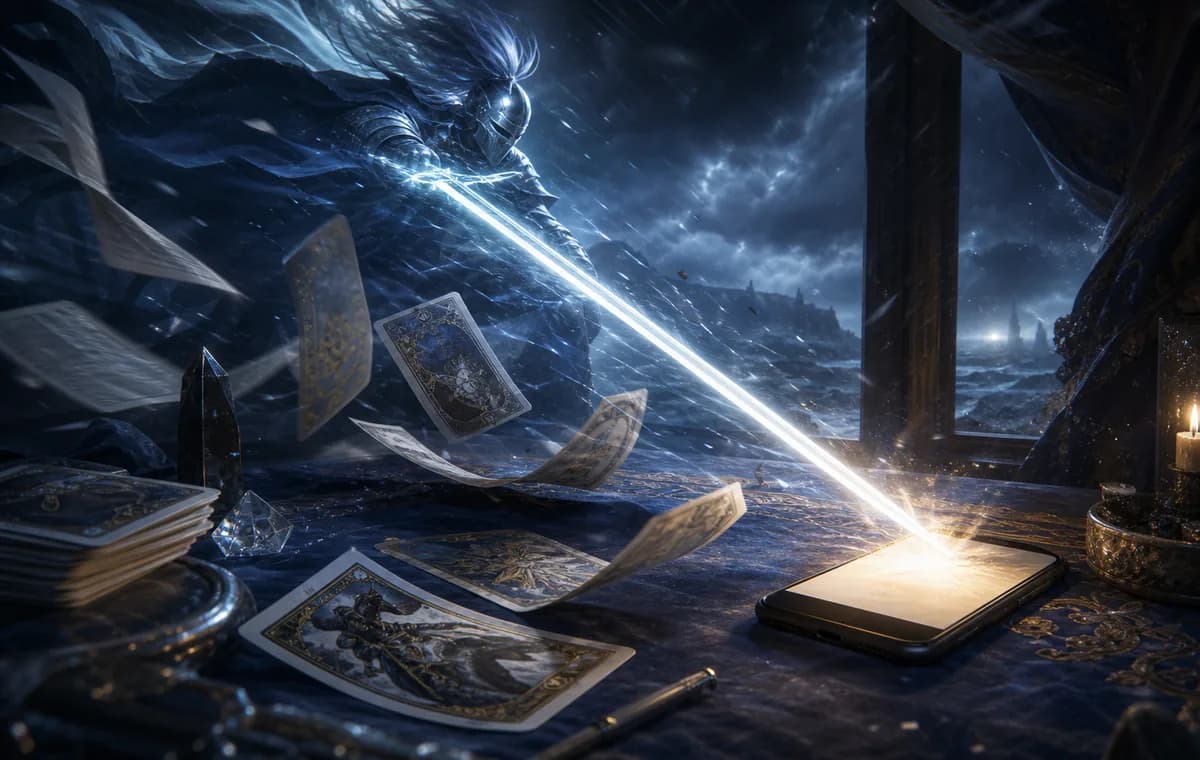
Picture the card: a rider charging at full gallop, sword raised, leaning into the wind, the clouds all blown one direction. This is the fastest card in the deck: Air, ruled by Gemini, everything has to happen now. When it describes someone's feelings, the feeling doesn't arrive as a question they're mulling over. It arrives as a conclusion already reached: they've decided how they feel, they can articulate exactly why, and they're moving on it before the thought finishes landing.
The attraction is mind-driven, not heart-driven. They're captivated by how you think: your banter, the way you argue back, the speed you keep. The classic signature is unmistakable: determination, restlessness and impatience braided together. They don't pine. They pursue.
But here's what no one asks about the picture: the raised sword is obvious, yet nobody checks where it's actually pointed: at you, or at the charge itself. Hold that question; it decides everything later.
When you're single or it's new
Enthusiastic and convinced. They've concluded you're worth chasing and they pursue hard, talk constantly, and want to lock it in before the momentum cools. It's flattering and a little overwhelming. There's no slow build; you go from stranger to central in about a week.
In an established relationship
Driven and devoted, but impatient. They push for decisions, hate stagnation, and want the relationship to keep moving somewhere. The long-term risk is that they mistake momentum for intimacy, keeping things fast because stillness makes them restless, not because the closeness needs it.
Knight of Swords Reversed as Feelings

Most guides flip this card straight from sweet to abusive bully with nothing in between, and that binary is lazy. The realistic middle, where most reversed Knights actually live, is scattered velocity: words running faster than the heart, defensiveness from insecurity, all gas and no aim. Not a villain. Someone whose conviction has come loose from its target.
The baseline still holds. Reversed brings turmoil and mixed signals, hot one moment, pulling back the next, plus miscommunication and blunt or argumentative texts that read harsher than they're meant. At the genuinely harsh end it shades into controlling or bullying behavior, and the surrounding cards tell you which read you're in. If a cutting Knight escalates into a real ending rather than a rough patch, the Ten of Swords as feelings confirms the wound was real and not just dramatic.
What makes this card unstable is structural. The certainty is a verdict, and a verdict can be appealed. Because the feeling lives in the head as a conclusion, it flips the instant a better argument or a more exciting target shows up.
From a crush
Fast, blunt, overthinking-fueled messages: the kind that arrive at 1 a.m. and contradict the ones from that afternoon. The interest is real, but it's unaimed and unstable, and easily redirected toward whoever else holds their attention this week.
From an ex during no contact
A restless impulse to re-contact, easy to misread as longing. Read it carefully: an impulsive, blunt reappearance is not the same as a settled return. The Knight reaches out because sitting still is unbearable, not necessarily because he's chosen you again. That distinction is the whole next section.
After a Knight of Swords Goes Hot-Then-Silent: What Happens Next, and When

Here's the claim no top page commits to: because this is the fastest card in the deck, reversed it predicts a specific, falsifiable pattern, a behavior with a clock on it. After a Knight of Swords contact goes hot-then-silent, expect a sudden blunt message or a sudden silence, within days, not weeks. This card doesn't do the long ambiguous fade. It resolves.
What the resolution looks like:
- The timing. Re-contact or definitive silence lands in roughly days, not weeks. If a week passes with nothing, that itself is the answer.
- The tone. The message is blunt, clipped, or argumentative, not a soft, warm paragraph. A long tender essay is a different card entirely.
- The trigger. It's impulsive, set off by their boredom or a fight elsewhere in their life, not by reflection about you.
- The reversibility. It can snap back to silence just as fast. One unsatisfying exchange and the horse wheels away again.
Now the distinction everything turns on: a real return versus a boredom-driven reappearance. They look identical at first, same fast text, same charge, and only diverge on contact with resistance. A real return survives your slow reply and shows up with a reason; a boredom reappearance dies the first time you're unavailable, and the horse turns toward the next target.
I call it the first-friction test. Conviction and impulse are indistinguishable for the first 72 hours; what separates them is what happens the first time you're slow to answer, unavailable, or you disagree. Last winter a regular in Shinjuku ran it on purpose. A man's Knight-of-Swords pursuit had felt overwhelming, so she waited four hours to reply. He didn't cool; he escalated, asking what was wrong, wanting to fix it, pushing toward her. That was the tell that the sword was aimed at her and not just swinging. Aimed velocity slows down and engages under friction. Raw velocity goes looking for the next thing that moves fast.
That resolves the question I planted about where the sword points, and it reuses the spine of this cluster: speed isn't certainty. The Knight gives you a flood of thought, not a wave of feeling, and a flood drains as fast as it rose.
The pattern to name outright is love-bomb-then-ghost: the charge is in love with the charge. The intensity is real, but it's intensity about pursuing, and once the pursuit stops thrilling it evaporates. Watch the second week — did the velocity start asking about your actual day, or stay a performance that needs an audience? For an ex specifically, layering a will my ex come back tarot spread over that blunt reappearance tells you whether there's a real return underneath the impulse, or just a bored rider passing through. The adjacent diagnostic is the Ace of Wands as feelings: a spark is ignition, not fire, and the same caution applies.
Is the Knight of Swords a Yes or No for Love?
Upright, it's a fast, emphatic yes, but a conditional one, because the certainty is a verdict that can be overturned. Reversed reads as a maybe, unstably: mixed signals rather than a flat no, the feeling real but unaimed. The honest caveat most readers skip past in the rush of getting a yes at all: a Knight of Swords yes tells you the feeling is strong and quick, not that it's settled. Pair it with a card that grades for staying power, something earthy and slow, before you bet anything on the speed. If you ever pull this card beside its mirror opposite, it's worth reading them against each other: the Knight is all decision and no pause, while the Two of Swords as feelings is all pause and no decision.
Does the Knight of Swords Mean They're Thinking About You?
Yes, and loudly, in their head, in words. This is the most verbally active thinking about you card in the deck; if they're thinking of you, you'll usually hear about it fast. The flip tell is just as useful: a Knight of Swords with zero visible pursuit often means the velocity simply isn't aimed at you right now. The charge is real, just pointed elsewhere. With this card, silence is information, not mystery.
Knight of Swords vs Knight of Cups as Feelings
These are the two knights people most often confuse, and the difference is clean once you see it. The dry knight, Swords and Air, charges with conviction: fast, blunt, mind-led, certain. The wet knight, Cups and Water, woos with feeling: romantic, dreamy, heart-led, idealizing. The Knight of Swords argues you into it; the Knight of Cups as feelings serenades you into it. Swords hands you a verdict. Cups hands you a poem.
They share a failure mode in different flavors: both can be in love with the rush rather than with you. But the Swords rush is winning and being right, the Cups rush is falling. If you pulled both, or you're torn between two people who feel like one of each, the test is the same: which warmth survives an ordinary, unexciting week? For the opposite tempo entirely, the King of Pentacles as feelings shows feeling through provision and quiet acts of service, the slowest, steadiest love language in the deck.
How the Japanese Tarot Tradition Reads This Card
In Japanese タロット占い, I read the upright Knight's urgency through 「焦り」(aseri) — restless impatience, the feeling of being driven to rush before things are ready. It names the engine of this card precisely: not malice, not even shallowness, but the pressure to act now that won't let the rider wait for the ground to settle.
The contrast that sharpens it is 間 (ma) — the meaningful pause, the charged empty space Japanese aesthetics treat as essential rather than wasted. The Knight of Swords is the one card with no ma at all, and that absence is where the caution sits. As a teacher of mine framed it: the speed is honest — he really does feel it now — but aseri is not the same as conviction tested by time. Read it as a real current that hasn't yet learned patience.
Frequently Asked Questions
What does the Knight of Swords mean as feelings?
Intense, fast-moving, mind-driven attraction: they act on the feeling immediately rather than sitting with it, and the pull runs through your wit and conversation more than tender sentiment. Upright the energy is decisive and all-in. They want you and they want it now. Reversed it scatters into mixed signals and blunt, argumentative contact. The one caution that matters: speed isn't the same as settled certainty.
Is the Knight of Swords a yes or no for love?
Upright it's a fast, emphatic yes, but a conditional one, because the certainty is a verdict the head can overturn the moment a better argument or exciting target appears. Reversed softens to maybe, unstably rather than a flat no: the feeling is real but unaimed. Treat any Knight of Swords yes as strong and quick, not necessarily lasting.
What does the Knight of Swords reversed mean as someone's feelings?
Reversed flips the speed into turmoil: confusion, mixed signals (hot one moment, pulling back the next), miscommunication, and blunt or argumentative messages; at the harsh end, controlling or bullying behavior the surrounding cards confirm. The realistic middle most guides skip is scattered velocity — words faster than the heart, defensiveness from insecurity. The feeling is usually real but disorganized and easily redirected.
Does the Knight of Swords mean someone likes you?
Usually yes, and they won't be subtle. This is the most verbally active they like you card in the deck, expressed through pursuit, banter and fast contact. The nuance is direction: is the charge aimed at you or at the chase itself? If there's zero visible pursuit, the interest may simply be pointed somewhere else.
How does the Knight of Swords feel about an ex?
Upright, restless and determined to win you back: a genuinely positive reconciliation sign, the energy of someone who has decided and wants to act now. Reversed or during no contact, the impulse to re-contact is real but unstable: an abrupt blunt reappearance is not the same as a settled return. Run the first-friction test first, because a real return survives your slow reply.
Is the Knight of Swords a good card for reconciliation?
Upright, yes — it shows someone driven and impatient to fix things fast, which favors a quick reopening of contact. The risk is durability: this card reconnects on impulse and can snap-reverse just as quickly, reopening the door without guaranteeing it stays open. Layer it with a will-my-ex spread and watch whether the return survives the first slow reply or disagreement.
What does the Knight of Swords mean for how someone feels about you?
They've reached a clear, articulate conclusion about you and feel certain of it now, but it lives in the head as a verdict, not the heart as a slow-built attachment. That makes the feeling strong, direct and conditional, revisable the moment a more convincing argument appears. Read the intensity as real and the permanence as unproven.
Closing
Before you read the speed as love, run one test: be slightly unavailable, just once, and watch which way the horse turns — toward you, or away. That single moment tells you more than any flood of fast texts. Expect a blunt message or silence within days; a real return survives the slow reply, a boredom flare doesn't. Speed isn't certainty.
For a fuller layout before you bet on the velocity, our love tarot spread guide builds out a reading for exactly this kind of question, and if you're parsing a half-open door after a hot-then-silent ex, the reconciliation tarot reading guide walks you through what to do with it.