A client sat across from me in Shibuya holding a Ten of Swords reversed and asked, very softly, whether it meant her partner was healing. He had not replied in eleven weeks. Three blogs she had read that morning all used "recovery." That moment was when I decided the Ten of Swords as feelings had to be written differently. Every guide names the same binary — stabbed in the back versus laid down themselves — and refuses to translate it into anything you can watch for in two weeks. That translation is the point.
Quick Answer
The Ten of Swords as feelings describes total emotional collapse — past anger, into flat exhaustion. The crucial split is agency: were they cut down (betrayal, blindside) or did they lay themselves down (chosen surrender)? Reversed does not automatically mean healing — it splits into early healing, refusing to get up, and false dawn. You will leave with behavioral signals, not emotion words. For the upright and reversed reading beyond feelings, see the full Ten of Swords tarot card meaning.
Ten of Swords Upright as Feelings

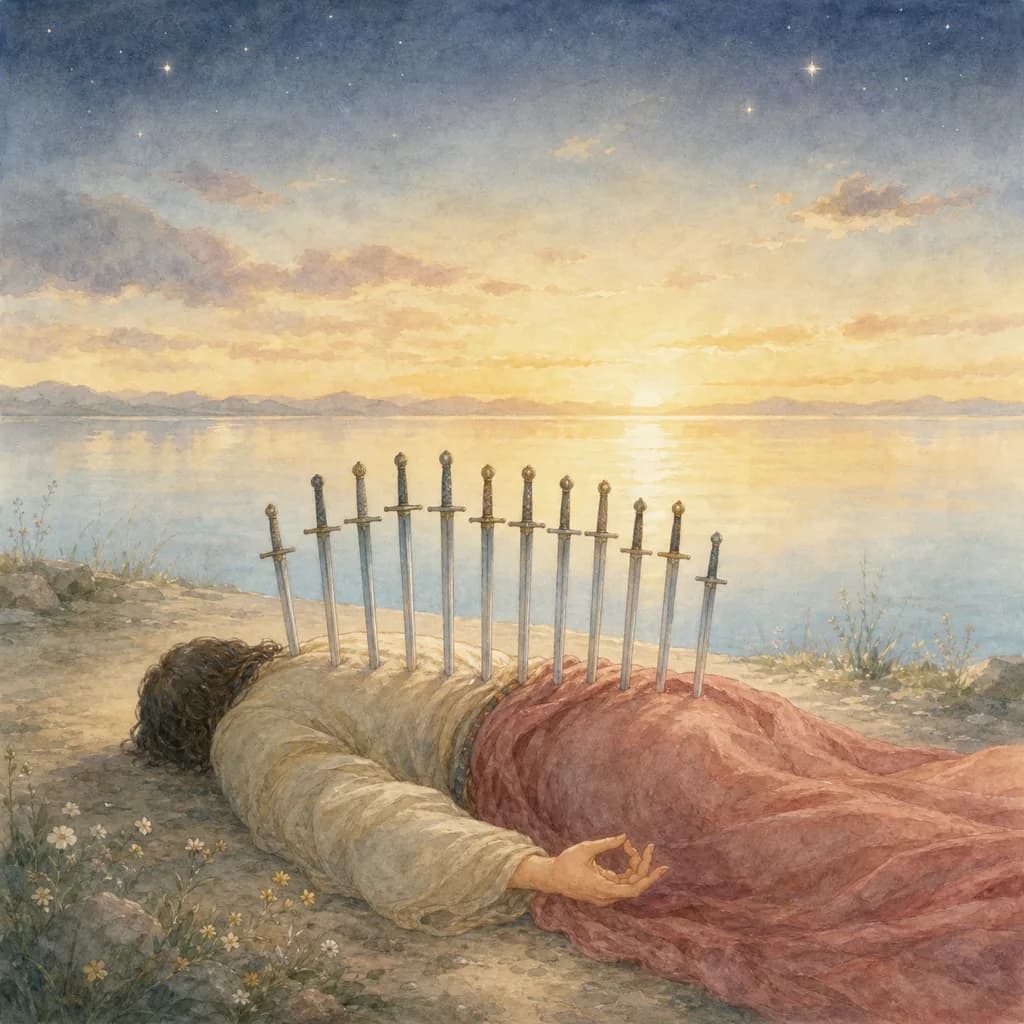
A figure prone on the ground, ten blades in the back, calm water in front, dawn on the horizon. The maximum number of blades says the wound is total. The calm water says the fight is over. The dawn says something comes next — but the figure is not yet standing to meet it.
What almost every English guide drops is that the same image describes two opposite inner states. In the first, something was done to this person — a betrayal, a blindside, news that dropped them. In the second, the person laid themselves down because they could no longer hold the relationship up. Identical from outside; opposite inside.
The Ten is post-anger. Three is bleeding in real time, Nine is lying awake catastrophizing, Ten is the morning after both. Expect flatness. The absence is the signal.
The Shibuya client kept pulling this card reversed for the partner who stopped replying. She read it as healing. What it was actually showing — once we ran the decoder — was Pattern B: silence latency past two weeks, no closure attempt. The card was telling her he had chosen not to get up.
Singles or a New Connection
For a new connection, the upright Ten almost always describes a previous wound bleeding into the present rather than anything about you. They were laid out by an earlier ending and are meeting you while still on the floor. Not about you, not yours to fix.
In an Established Relationship
Your partner has hit a wall. The wall has already happened — the work is to read which agency the card describes. If they were cut down, the wound needs witnessing before any repair conversation is hearable. If they laid themselves down, no number of conversations will reverse that in week one.
Ten of Swords Reversed as Feelings

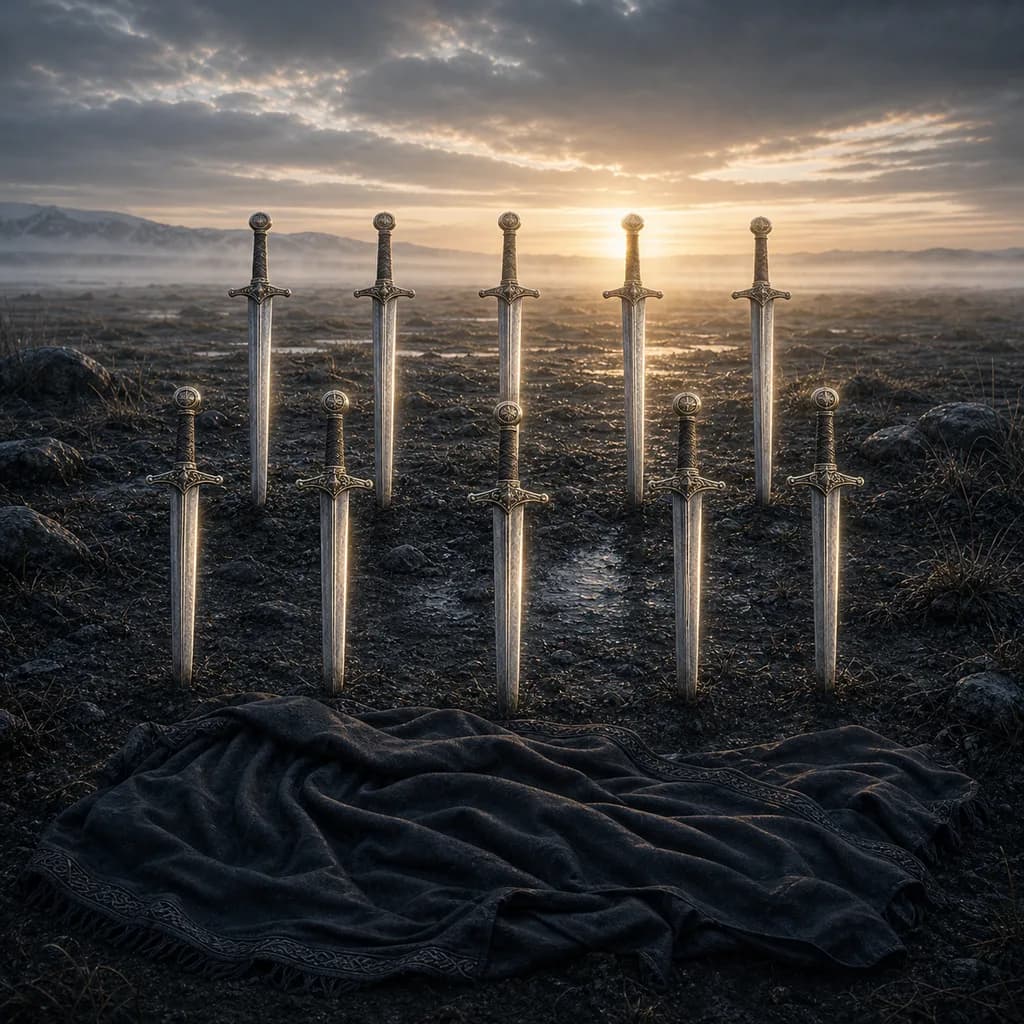
Reversed, the swords slip out. Most guides translate that as "healing," which is wrong about two-thirds of the time. The slip is not the standing. Three distinct states share this reversal.
Genuine early healing. They are tired but the worst is behind them. The blades are leaving. They can imagine a future that is not you — which sounds like bad news and is the prerequisite for any future that might include you.
Refusing to get up. Same collapse as upright, now performed. They replay the wound, polish it into a story, post about it obliquely. Most likely to keep producing the same draw if you re-shuffle.
False dawn. They have decided to "move on" before any actual processing. They sound bright. The wound will resurface — nothing has metabolized; it has only been bypassed.
A Crush
A reversed Ten from a crush is usually state one or two — they are carrying an older collapse into the new connection. Patience over pursuit.
An Ex, or No-Contact Period
The default reading — that the reversal means "they are healing back toward you" — is wrong more often than right. Most of the time, a reversed Ten about a silent ex is state two or three. Only the behavioral decoder tells you which is live.
The Behavioral Decoder: What Happens in the Next 7 to 14 Days
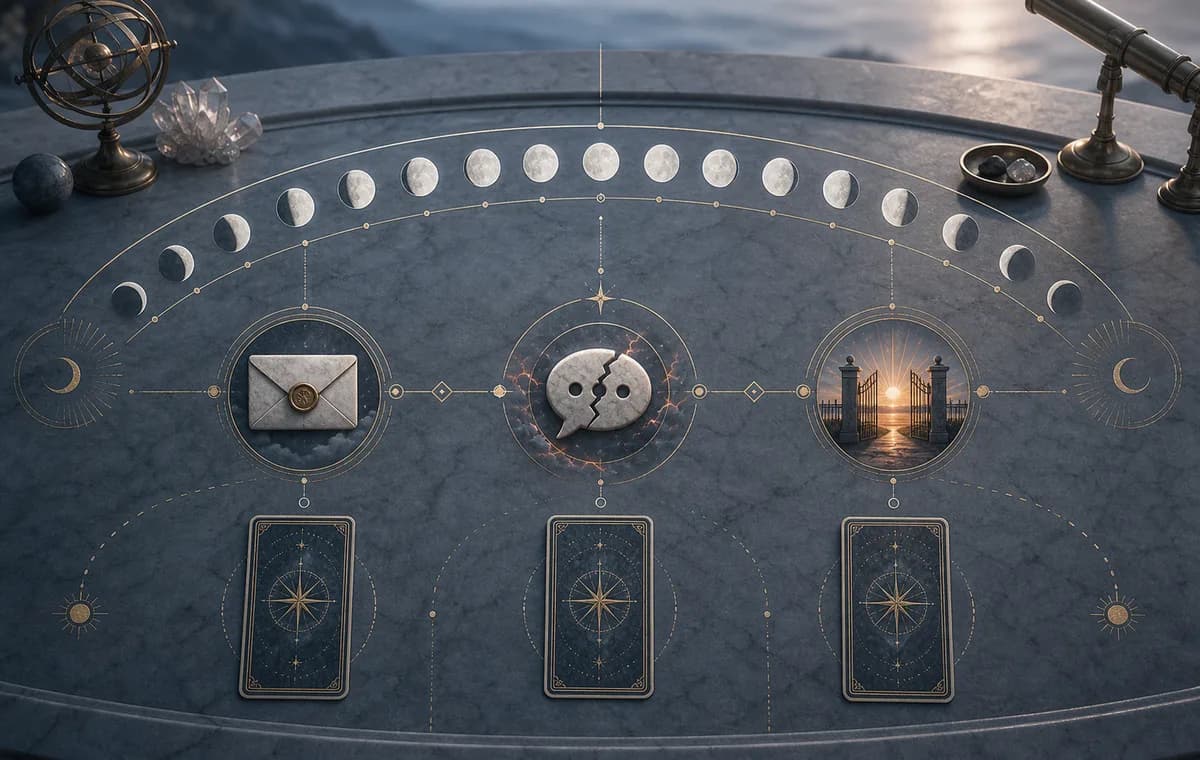
Knowing they feel collapsed is useless unless you know what collapse will do. Across hundreds of post-Ten readings in Tokyo, three behavioral patterns repeat almost cleanly. You can watch for them inside two weeks.
Pattern A — the "stabbed" read. Wounded, reachable, still inside the story. Expect a closure attempt within seven to fourteen days — a long late-night voice note, a paragraph-length message. Silence latency 24 to 72 hours between pings, not weeks. Vague-posting implies blame without naming anyone. Most diagnostic spreads (including our will my ex come back tarot spread) mirror this pattern.
Pattern B — the "laid down" read. Flat one-liners or full ghost. Silence latency two weeks or longer, no anniversary nudges, no closure attempt. Social goes dark or sanitized. From outside, Pattern B looks like Pattern A on a slow day; the fourteen-day window separates them.
Pattern C — reversed early healing. Occasional warmth without opening. Replies kind but not lengthening. Slow rebuild of normal life signals — a friend tagged in a photo, a return to a gym schedule. Do not mistake these for re-entry. Pattern C says they are no longer on the floor, not that they are walking toward you.
For Pattern A: acknowledge the wound, do not defend yourself in week one. Pulling for language too early turns it defensive. Another Tokyo reading this spring looked identical on the surface — within ten days he sent a long, late-night voice note, disappeared, then resurfaced. Pattern A signature, clean as a textbook. For Pattern B: do not chase. Reading the silence through a betrayal lens will make you confirm their decision. For Pattern C: match the cadence. Do not escalate.
The card already told you which one. The behaviors will confirm it inside two weeks. The mistake is needing to know in two hours.
Three vs. Nine vs. Ten of Swords as Feelings: The Discrimination Table
Readers mix these three Swords endings up constantly. None of the top guides put them side by side.
| Card | Phase | Feeling | Text Behavior | Duration |
|---|---|---|---|---|
| Three of Swords | Pierced, present-tense | Acute pain, bleeding | Outbursts, accusatory messages | Days to weeks |
| Nine of Swords | 3am replays, mental loop | Anxiety, catastrophizing | Anxious paragraphs, what-if loops | Weeks to months |
| Ten of Swords | Collapsed, post-fight | Flat exhaustion, done-ness | Minimal contact, flat tone, silence | Two to twelve weeks |
The Three is the wound happening. The Nine is the mind torturing itself with the wound. The Ten is after both. Mistake a Three for a Ten and you under-react; mistake a Ten for a Three and you over-reach. See Three of Swords as feelings for deeper context.
What the Seeker Should Not Do When Ten of Swords Lands
Do not push for an explanation in the first week. Collapse does not have language yet. Early in my practice a client texted her partner an essay-length defense the morning after we pulled this card. She wanted to head off the collapse; she hardened it instead. He had been between Pattern A and C, and her urgency pushed him to B. The worst thing you can do to a person on the floor is stand over them demanding they explain why they fell.
Do not read silence as automatic proof of betrayal — the laid-down read is silent for a different reason. Do not re-shuffle hoping for a softer card; the Ten does not soften by being asked twice. Do not project the sunrise onto next Tuesday — the dawn is a horizon, not a date. Do not perform reconciliation theatre at someone in Pattern B; it will harden the no.
Ten of Swords vs. Eight of Cups as Feelings
Both cards live in "they're leaving" territory. The difference is posture. The Eight of Cups as feelings shows someone getting up and walking away — agency, motion, a horizon. The Ten of Swords shows someone already horizontal. Eight of Cups feelings tend to be sad but clear; Ten of Swords feelings tend to be flat and post-fight. When both appear together, read the Eight as the chapter after the Ten — they have to lie down before they can stand up to leave.
How Japanese Tarot Tradition Reads This Card
In Japanese タロット占い, ソードの10 is most often read through 「どん底」(donzoko) — the absolute bottom. That framing names the bottom as a place, with directions out of it, rather than a final verdict. Pair it with the proverb 「夜明け前が一番暗い」 — darkest just before dawn — and you get the way my teacher taught me to hold this card: keep the sunrise alive without rushing it onto the calendar.
When reversed, she used 「立ち直り」(tachinaori) — literally "standing back up" — never "healing." The card is not about whether they feel better; it is about whether they stand. That is why the next card in the inner journey is so often The Fool — once tachinaori begins, the figure can pick up a stick and walk again.
Frequently Asked Questions
What does the Ten of Swords mean as feelings for someone?
Total emotional collapse — past anger, into flat exhaustion. The crucial split is agency: were they cut down (betrayal, blindside) or did they lay down themselves (chosen surrender)? Their behavior in the next two weeks tells you which.
Is the Ten of Swords a yes or no card in love?
Upright it leans no, but the more useful read is "not in this current shape." Reversed nudges toward a fragile maybe — only if both people are willing to start from the floor rather than pretend the collapse did not happen.
What does the Ten of Swords reversed mean as feelings?
Three distinct things — genuine early healing, refusing to get up, or false dawn. Cadence, latency, and whether they reach out are what separate them. Compare with The Star as feelings when the reversed Ten leads into genuine calm-after-collapse.
Does the Ten of Swords mean my ex is thinking about me?
Usually yes, but read what kind. In the stabbed read they are replaying the wound and you are in the replay. In the laid-down read they are thinking about the relationship as a closed chapter. Neither, by itself, means they will reach out.
Can the Ten of Swords mean betrayal in a relationship?
Yes — the stabbed-in-the-back read is the classic betrayal signature. But not every Ten is betrayal; sometimes the person laid themselves down because they could no longer hold the relationship up. The collapse-from-outside reads sit close to The Tower in feel. Contrast it with Death as feelings too: Death is an organic, willing transformation, where the Ten is sudden, unwilled collapse — an ending that happens to the body on the ground.
What does the Ten of Swords mean for a breakup?
It marks the end as already energetically real, often before either person says the words. The work is no longer about saving the version of the relationship that just died — it is about deciding whether anything new can be built on the floor.
Is the Ten of Swords always negative in a love reading?
No, but its positive read is not optimism — it is finality being clarifying. Many clients describe it as the first card that let them stop arguing with themselves about whether the relationship was already over.
Closing
Watch the next two weeks before you act. Do not interpret silence on day three; do not write a defense on day four; do not re-shuffle on day five. Let the behavior tell you which agency read you are looking at. For readers landing here during a cooling-off period, the reconciliation tarot reading guide is the next step. For a fuller spread, our love tarot spread guide opens out from here.