Three weeks ago he texted at noon and planned a trip neither of you had time for. Now it's nine days of silence and you're drafting your fourth version of I miss you, can we talk? The Knight of Wands as feelings is the card behind that exact whiplash, incandescent one week and gone the next, and almost every guide tells you what it means, then leaves you holding the phone. This one tells you whether to send the text, and what to write instead.
Quick Answer
Knight of Wands as feelings means intense, fast-moving, impulsive passion. They're lit up right now and want to act before the feeling fades. Upright reads confident, charming, built for the chase; passion leads and commitment lags far behind, so the heat is real but unproven. Reversed turns scattered and hot-and-cold, all breadcrumbing and stop-start energy, but the feeling is genuine, just unsteady, not gone and not fake. The only live variable is whether the fire is aimed at you or at the adventure of you.
Knight of Wands Upright as Feelings

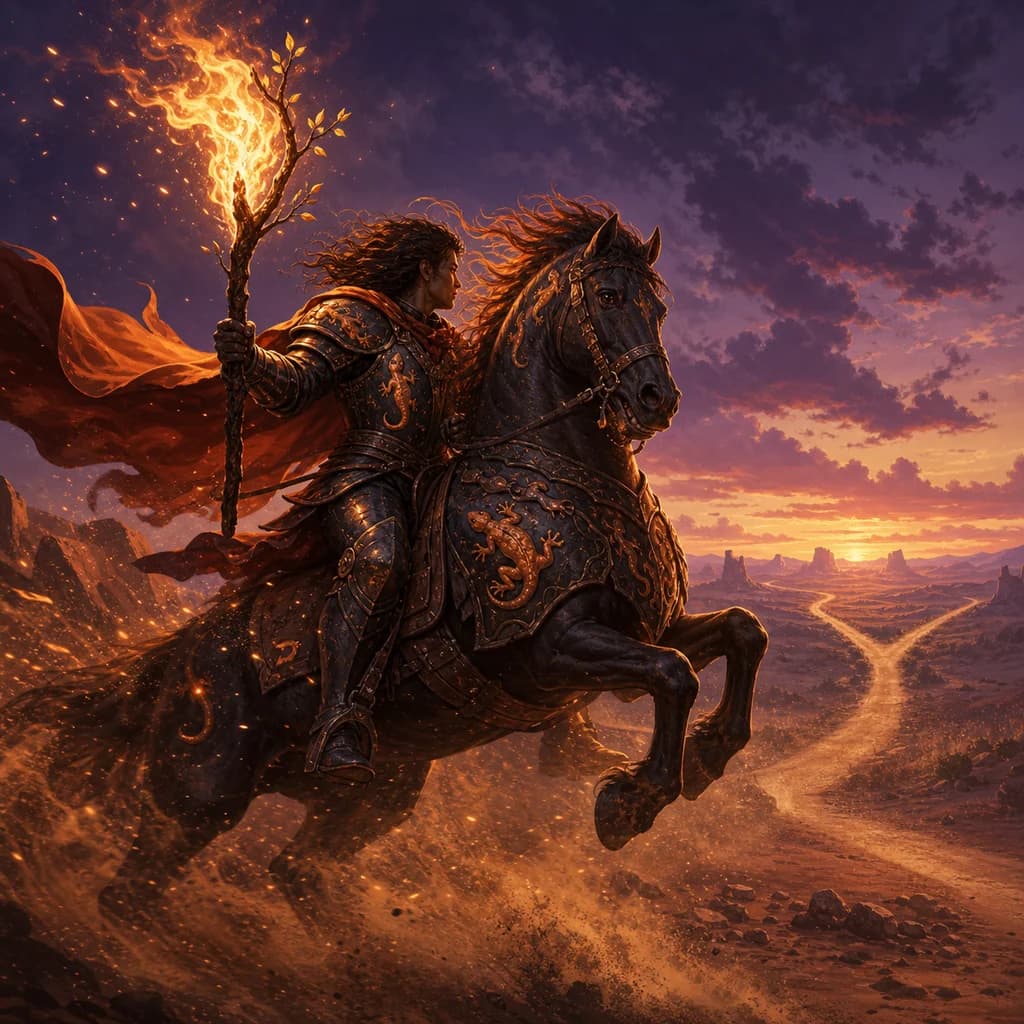
This is the King of Wands' fire two decades earlier: declared, enacted, witnessed, but without the throne, the plan, or the staying. The King of Wands as feelings owns the suit grammar, so I won't re-explain it. What the Knight adds is velocity: present-tense, full-gallop desire that says I want this NOW. It leads with attraction, not planning, strongly physical and often openly sexual, arriving as a jolt rather than a slow warming. He's not playing it cool. Where the Eight of Wands as feelings is the velocity of the feeling itself — the rush of messages and momentum — the Knight is the person doing the chasing, a rider you can actually name.
Here's the trait every guide names and undersells: he lives for the pursuit. For this rider the chase is often the whole of the feeling, which is why the heat can cool the moment you've been won, when there's nothing left to ride toward. That isn't a flaw in his character. It's the engine of the card itself. This is passion off the leash — compare the Chariot as feelings, where the same fire is harnessed and pointed at a destination; the Knight just rides toward the heat.
Single or new connection
Fast, physical, impossible to misread as lukewarm. He pursues hard and treats your attention like territory to win. Enjoy it — and notice the pace is set by the chase, not by you. Nothing here has met an ordinary Tuesday yet.
In an established relationship
The real test of the upright Knight. Some keep courting inside the commitment, restless energy redirected into the relationship itself. Others go quietly flat the month after you said yes, not because the feeling died but because the frontier did. Watch which one you're living with.
Knight of Wands Reversed as Feelings
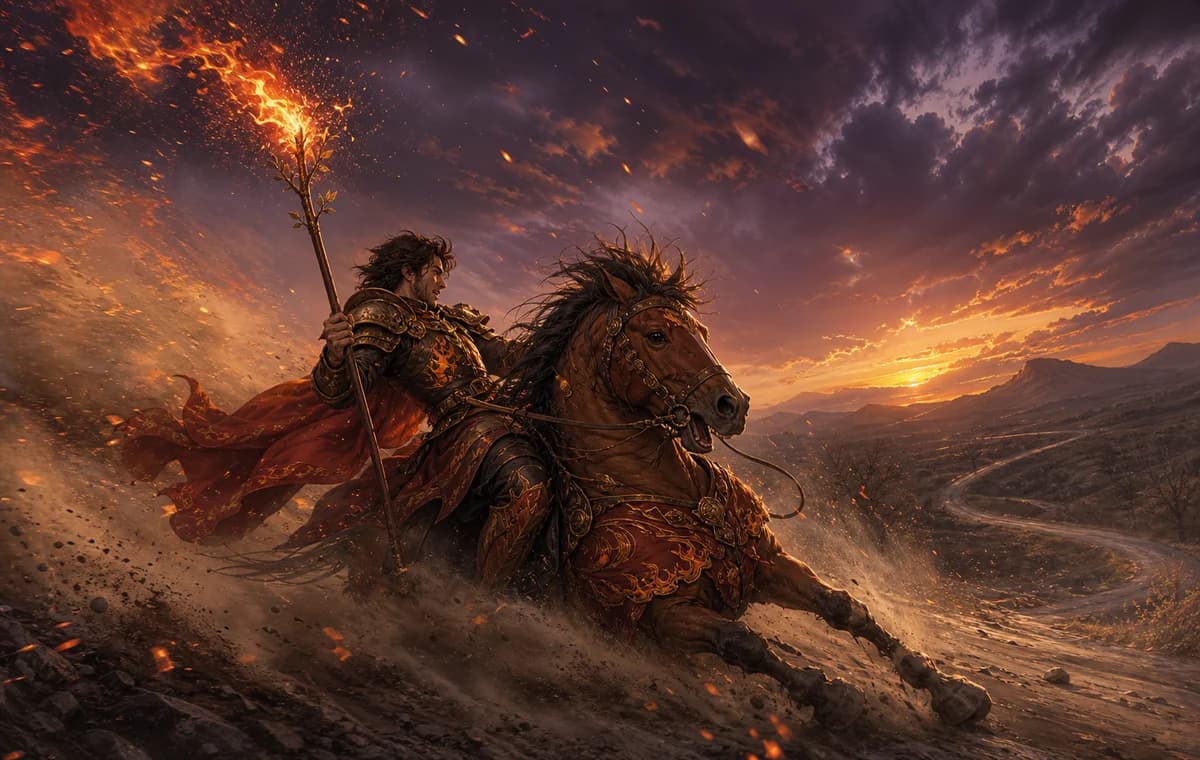
Before any interpretation, the stance, because this is the misread I correct most often: reversed here is almost never no feeling. People flip the Knight, see the stumbling horse, and assume the fire went out. It didn't. Reversed is genuine fire that's unsettled: frustrated, impatient, unsure how to express itself. The voltage still reads charged; it's the steadiness that's gone.
Two flavors. The first is enthusiasm that fizzled before anything solid formed: he sprinted in, the sprint outran whatever was being built, and it collapsed under its own speed. The second is overwhelmed-by-his-own-momentum: he went in so fast he startled himself and doesn't know the next move. Neither is malicious game-playing. Both are motion-confusion wearing the costume of indifference. The breadcrumbing is real, but read it as a man who keeps mistaking a new spark for a new direction, not one running a strategy.
For a crush, reversed warns of inconsistency more than absence. For an ex or during no contact, read the same restlessness; if the door looks half-open, the reconciliation tarot reading guide tests whether it actually is.
Is the Fire Aimed at You, or at the Adventure of You?

This is the question that resolves the entire reading. Most guides describe the heat without telling you what it's pointed at, which is the only thing you actually came to learn. The problem: exciting because new and exciting because you are indistinguishable at full gallop. They diverge only once the chase ends, which is exactly when most people stop reading the card and start panicking instead.
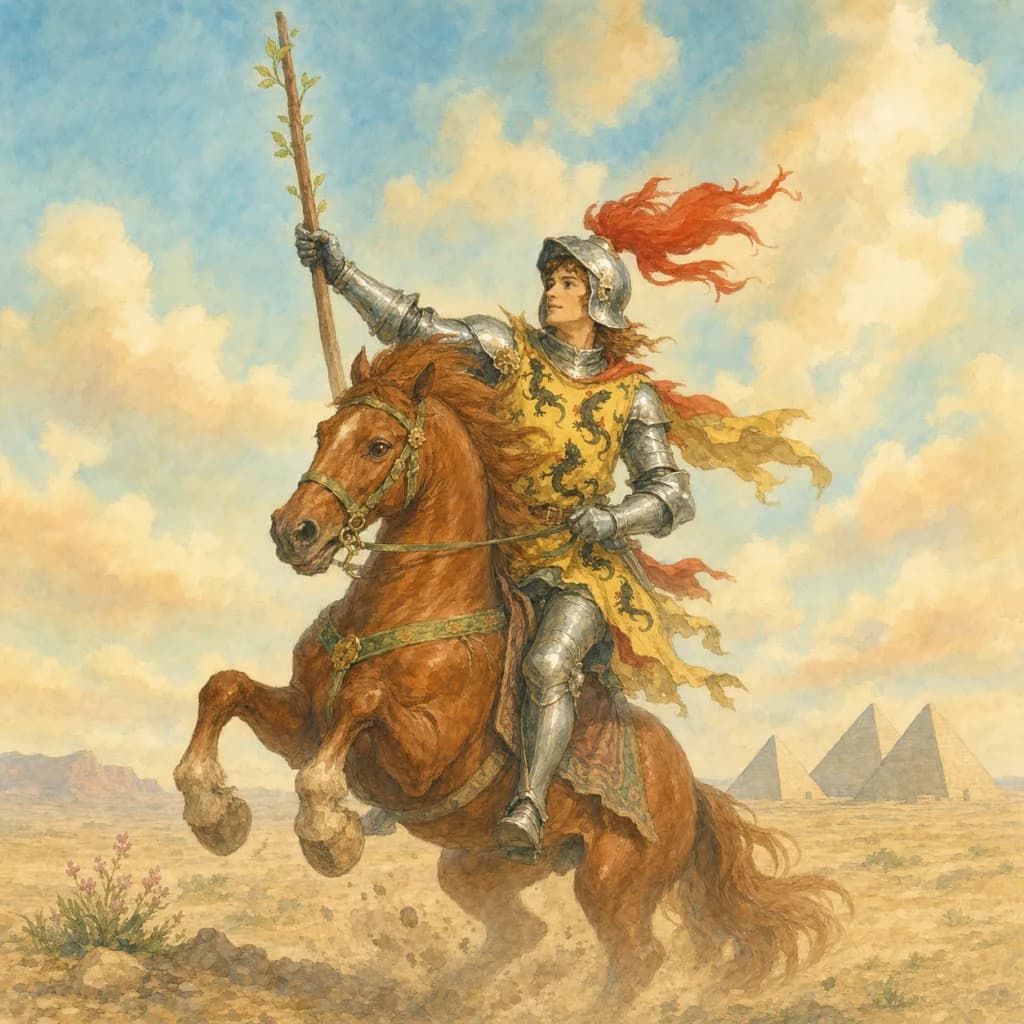
The horse is the tell, the symbol worth reading for feelings. The Knight rides a rearing horse he does not own. He's the suit's traveler, attached to motion, and a rider can change direction without lying about how hot he was while pointed at you. Sit with that, because it dissolves the cruelty: the intensity was never fake; the destination is the only thing in question. The same energy lives in the Page of Wands as feelings before it learned to gallop, the spark that hasn't yet figured out it can move.
So here is the test, and it's falsifiable. Remove the chase. Become reachable, settled, un-pursued, ordinary. Stop being a frontier. Then watch which way the heat moves. If it converts into staying, it was aimed at you. If it goes hunting a fresh fire to ride, it was aimed at the adventure.
Which brings the reframe that matters most. With a Knight of Wands, was it real? is the wrong question. It was always real, so stop doubting your worth over a heat that was never in doubt. The right question is was it about me? That one move drags the whole thing out of your self-esteem and into a diagnosis of his attachment-to-motion, where it belongs. One clean contrast to keep the cluster straight: the King's heat is witness-dependent, so go quiet and see if he stays warm with no one watching. The Knight's is destination-dependent, so go still and see if he stays warm once there's nowhere new to ride.
He Went Cold — Should You Text Back, and What Do You Actually Say?
A copywriter named Saki came to my table in Shimokitazawa with a screenshot of a Knight-of-Wands man's message that had sat unanswered for nine days. She'd drafted three versions of I miss you, can we talk? and asked which to send. I told her to send none of them, because every one of them was a "mission accomplished" flag, and to reply instead with a single line about the ramen queue she was standing in. He proposed a plan within two days.
Here's the paradox most advice leaves dangling. You'll hear don't be clingy and also availability reduces interest, as if those were two warnings to balance. They're one. The kill-signal with this rider isn't affection, since affection was never the problem. It's the surrender of your own motion. You go cold to him by going still: he reads a stationary target as a finished conquest, and a finished conquest is the one thing a Knight of Wands cannot stay interested in. That single insight tells you whether to reply, and how.
Reply or not. Reply, but as a moving frontier, not a destination that's stopped moving. A warm, short, non-pursuing line with your own forward motion in it keeps the chase alive: was just heading to Nakameguro for coffee, you should've seen the line. That's reachable, not waiting. The kill-version (why did you disappear / I miss you / when can we talk) hands him the won-conquest signal in three words. Both are honest. Only one keeps you somewhere he still has to ride toward.
Pacing. Match his cadence minus one beat. Never the one who replies first and longest, never the one waiting visibly by the phone. Reachable, not available.
What not to say. These are the availability tells he reads as mission accomplished. The relationship-status audit (so what are we?). The guilt-trip (you hurt me by going quiet). The over-explanation. The double-text into silence. Each one hands him the flag yourself.
The honesty caveat, because I won't dress manipulation up as insight: this only re-attracts a fire that was genuinely yours. It can't manufacture a feeling that was never aimed at you. And if becoming a frontier again is the only thing that reliably works, you've diagnosed a spark-bound rider, and a relationship that needs permanent chase-maintenance to stay warm has already answered your real question. A will my ex come back tarot spread reads whether the plan is real or only rhetoric. The hard stop: if no plan that happens in daylight ever materializes, only the midnight resurfacing and the warm word with no calendar behind it, stop feeding it.
The Three-Week Burnout, and Why It Isn't a Lie
Every guide reaches for the candle that burns twice as bright burns half as long and stops there. The fire didn't fade. It arrived. Once you were won, you stopped being the frontier, and this Knight's heat is bound to frontier, not to person. He didn't stop wanting you; you stopped being somewhere new to ride. That's not a lie. It's a destination problem in a feelings costume, and the Ace of Wands as feelings draws the same spark-bound-versus-fire-bound line at the root of the suit.
Knight of Wands vs Knight of Cups as Feelings
The deck's two romance knights, told apart by what each is chasing. The Knight of Wands chases the adventure of you: the motion, the frontier, the pursuit. The Knight of Cups as feelings worships the fantasy of you: the poem, the idealized image.
They fail the same way for opposite reasons. The fire knight's heat dies when there's nowhere new to ride; the water knight's dies when you stop matching the dream he projected. Same falsifiable test, two failure modes: stop being a frontier and the Wands knight cools; stop being a poem and the Cups knight cools. So if you draw both about one person, and people do, trust the Wands card for what he'll do and the Cups card for what he'll feel.
How Japanese Tarot Reading Sees the Knight's Fire
In Japanese タロット占い, the question put to ワンドのナイト is never how hot is the fire. The heat is taken as given. The question is whether it can 落ち着く (ochitsuku): settle, come to rest. Japanese love readings prize quiet consistency above almost everything, and 落ち着く is exactly what the galloping knight hasn't learned. The word my teacher reached for was 落ち着かない (ochitsukanai), unable to settle, and she meant it without contempt. The Knight is the suit's traveler; his love is bound to the road, not to any place on it.
Where the King's reading asks whether the fire is single-minded, aimed at one person whether witnessed or not, the Knight's asks something harder: whether it can stop moving long enough to be aimed at anyone at all. The suit's settled counterpart, the Queen of Wands as feelings, shows what that fire becomes once it has learned to hold still and let itself be approached.
Frequently Asked Questions
Is the Knight of Wands a yes or no for love?
Upright it's a hot, fast yes to attraction and pursuit, but a "not yet proven" on commitment, because passion leads and commitment lags badly with this rider. Reversed softens to a conditional, hot-and-cold maybe. A yes that can't stop moving long enough to land is not the yes you're hoping for.
Does the Knight of Wands mean someone likes me?
Yes, and intensely, in the present tense. They're lit up by you right now and rarely hide it; this is not a card that plays it cool. The only open question is whether the heat is aimed at you or at the adventure of you, which you only learn once the chase ends.
Will Knight of Wands feelings last or burn out quickly?
Often they burn out around the three-week mark, but not because the feeling was fake. The Knight's fire is bound to motion, so once you've been won and stopped being a frontier, the heat goes hunting somewhere new. Whether it lasts comes down to one tell: does the desire make a plan that happens in daylight, or only resurface in the silence?
What does the Knight of Wands reversed mean as feelings?
Scattered, impatient, hot-and-cold, breadcrumbing, but rarely "no feeling." Reversed is usually genuine fire that's unsettled: he went in fast and doesn't know the next move, so the stop-start reads as games when it's mostly overwhelm. Read his actions over his declarations.
What does the Knight of Wands mean as an ex's feelings?
Usually lingering, still-bright physical desire mixed with nostalgia for the excitement; the lust burns and he may genuinely still want you. But pride and ego often stop him reaching out first, and this is no reconciliation guarantee. Warm words without forward motion are just the chase talking.
How does the Knight of Wands feel about commitment?
He feels passionately and even declares it, but desire leads and the planning lags far behind. He lives for the pursuit and loses interest in the steady, everyday love that comes after the conquest. Commitment isn't impossible here, but it only shows when the fire learns to settle, when he stays warm with nowhere new to ride.
Closing
A man I read for near Shibuya Station kept pulling the Knight of Wands about himself, baffled that he'd been certain about three different women one spring and gone cold on each within a month of her saying yes. The card wasn't accusing him of lying. It was showing him a horse he didn't own, pointed at whatever was newest, and the fire had been real every time, which was exactly the problem. So don't ask was it real. It was. Ask was it about me, or the ride. The next time he resurfaces, reply with your own motion and zero pursuit, then watch whether a daylight plan follows inside two weeks. Before you act, lay a full spread with the love tarot spread guide and read the cards around the heat.