Most people meet the Queen of Swords and immediately decide she is the cold one. Sharp tongue, raised sword, that severe profile. In more than a decade reading the Rider-Waite-Smith deck in Tokyo, I have lost count of the clients who drew her and asked, with a flinch, "is this someone who doesn't like me?" The Queen of Swords tarot card meaning is the most consistently misjudged in the whole suit, for a simple reason: she keeps her warmth where you have to earn the right to see it, and she will not perform it for you in the meantime.
This guide goes past the standard "intelligent, independent, blunt woman" summary, working through her symbolism, the upright and reversed readings, the life areas where she changes a spread, the combinations I see most, and the one question that decides everything: is her sharpness wisdom that grief sharpened, or a wound still bleeding sideways?
Quick Answer
The Queen of Swords is a Minor Arcana court card in the suit of Swords, tied to the element of Air. Upright, she means clear-eyed honesty and hard-won independence: a perceptive, principled woman who thinks before she feels, tells the truth even when it stings, sets firm boundaries, and gives counsel you can trust because she will not flatter you, usually someone who has lived through loss and come out clearer rather than bitter. Reversed, that same clarity curdles into coldness, harsh criticism, defensiveness, or manipulation, with old pain driving it. As advice, upright says lead with your head and speak plainly. Yes / No: upright is a measured yes, reversed leans no.
Card Imagery & Symbolism
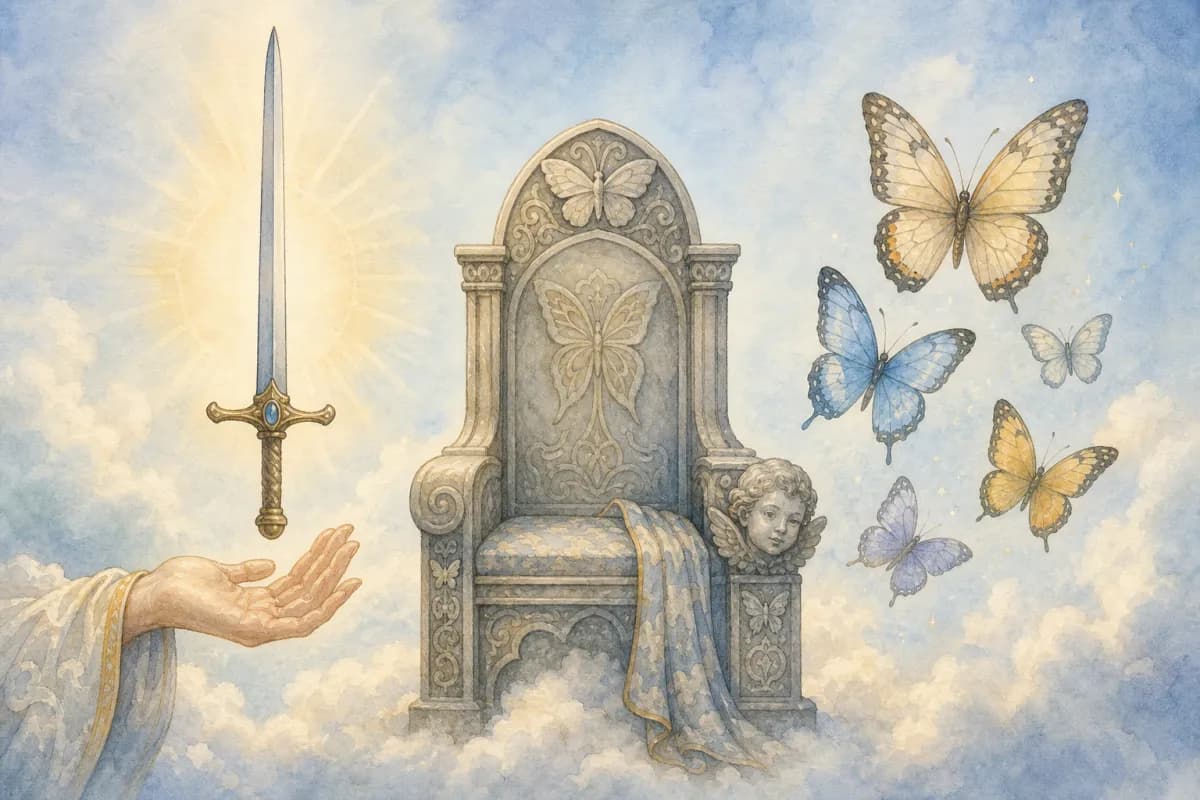
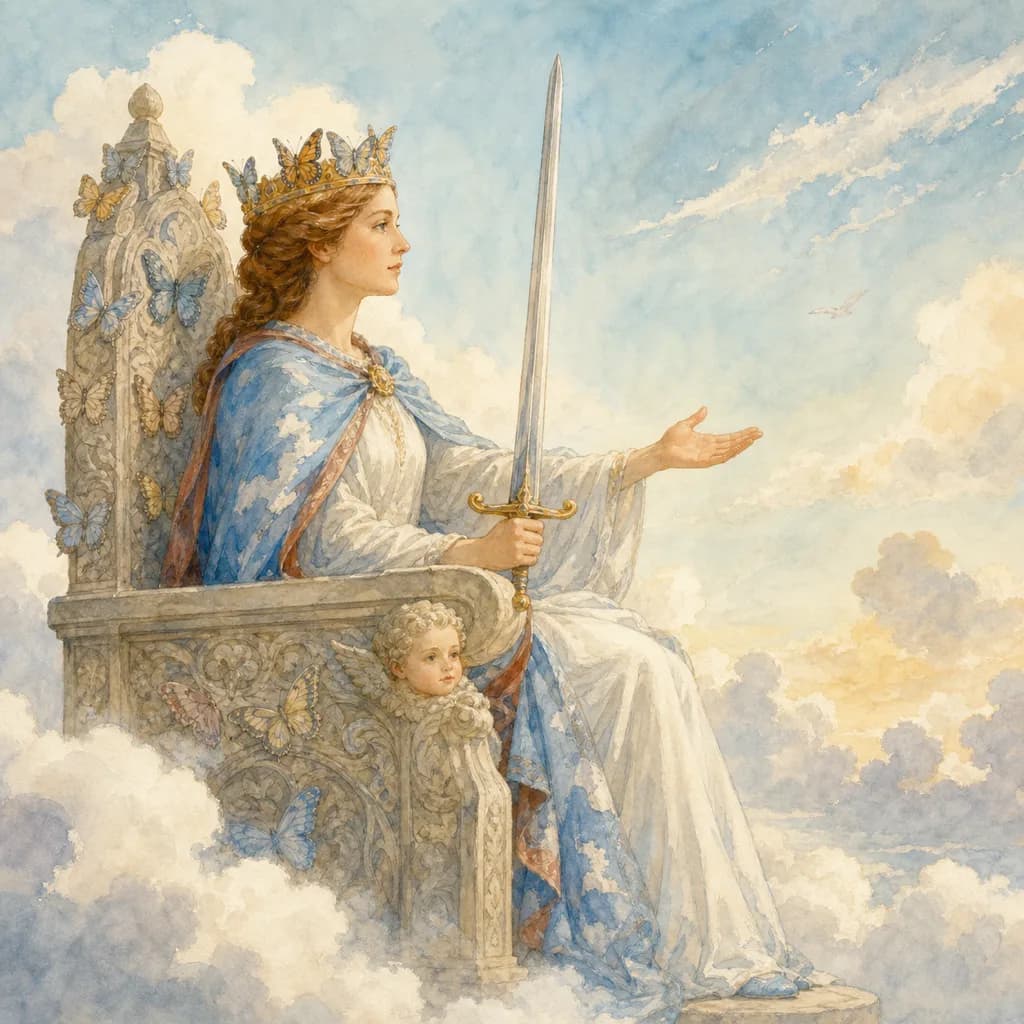
Look at the card before you interpret it. A queen sits in profile on a stone throne, high above a layer of cloud. She holds a sword upright in her right hand, raised toward the sky; her left hand is extended, palm open, almost in welcome. Her throne is carved with butterflies, the head of a cherub just visible at the armrest, and her crown is set with butterflies too. Most guides list these objects. Far fewer notice the card is staging an argument between two gestures at once.
The Sword and the Open Hand
The sword points up, the hand reaches out, and the whole card lives in the tension between them. The raised sword is her commitment to truth: held vertical, not lowered to strike and not sheathed, which means the truth is on the table and staying there. The open left hand is the part nearly everyone forgets. She is not only armed; she is receptive, a woman saying "I will tell you the truth, and I am willing to hear yours." When a client tells me she feels shut out by a Queen-of-Swords figure, I point at that open palm. The sword separates truth from comfort; it does not push you away.
The Throne Above the Clouds
Her seat is raised into the realm of Air, above the cloud line. The clouds are the emotional weather, the fog of feeling that makes other people lose their footing, and the Queen sits above it. She is not pretending the clouds are gone; she has climbed to where she can see over them. That elevation is her gift and her risk in one. From up there she judges fairly, and from up there she can also forget what the fog felt like, which is exactly how upright wisdom slides into reversed coldness.
The Butterflies and the Cherub
Butterflies are carved into her throne and set in her crown, the suit's signature of transformation, of a creature remade by what it went through. Then there is the small cherub's head at her armrest, the symbol popular guides mention and drop. The usual reading is that it stands for her softer side; I read it more specifically. Tenderness is the thing her hand rests on while she does the hard work of telling the truth, load-bearing, underneath the blade. Miss the cherub and you read a woman with no heart, instead of one whose heart is the part she guards most.
Queen of Swords Upright Meaning
Upright, the Queen of Swords is the deck's portrait of a mind clarified by experience. She is intelligent, perceptive, and direct, and the directness is not rudeness; it is respect that refuses to insult you with a comfortable lie.
Core Upright Keywords
- Clear-headed judgment — Facts seen without the distortion of wishful thinking
- Honesty — The true thing said, especially when it is the hard thing
- Independence — Self-sufficient, resilient, not waiting to be rescued
- Strong boundaries — Quick to name a line and hold it
- Perceptiveness — Reading people fast and accurately
- Hard-won wisdom — Clarity earned through loss, not handed down
In-Depth Upright Interpretation
When she shows up as a person, she is usually the one who tells you what everyone else is too polite to say: the friend who names the situation you have been agonising over in a single sentence, the mentor who does not pad the feedback. She reads as mature, often older or simply seasoned, and the surrounding cards tell you whether she is a literal individual, a role you are being asked to step into, or a quality the situation calls for.
That last possibility is where the card does its best work, and where other guides go thin. Drawn as advice, the Queen of Swords is one of the deck's strongest "think clearly and speak plainly" signals. She tells you to climb above the clouds: set the boundary you have been avoiding, have the honest conversation instead of the comfortable silence. Stop reading tea leaves, the Queen says, and ask the direct question.
A Tokyo client of mine, recently divorced, kept drawing the Queen of Swords through a whole winter. She read it as a verdict on herself: cold, alone, unlovable. I told her she had the card upside down in her head. The Queen of Swords is the widow who refused to let loss make her bitter, who took the heartbreak and came out with sharper sight and firmer edges. She was not being told she was hard; she was being shown the version of herself that had already survived the worst and could now choose clearly. By spring she had used that clarity to end a friendship that had quietly drained her for years, without a single cruel word. That is the upright Queen: honesty as a form of care. The trap is hearing "honest" and reading "harsh." She is not unkind; she is unwilling to lie to you, which is a different and rarer thing.
Queen of Swords Reversed Meaning
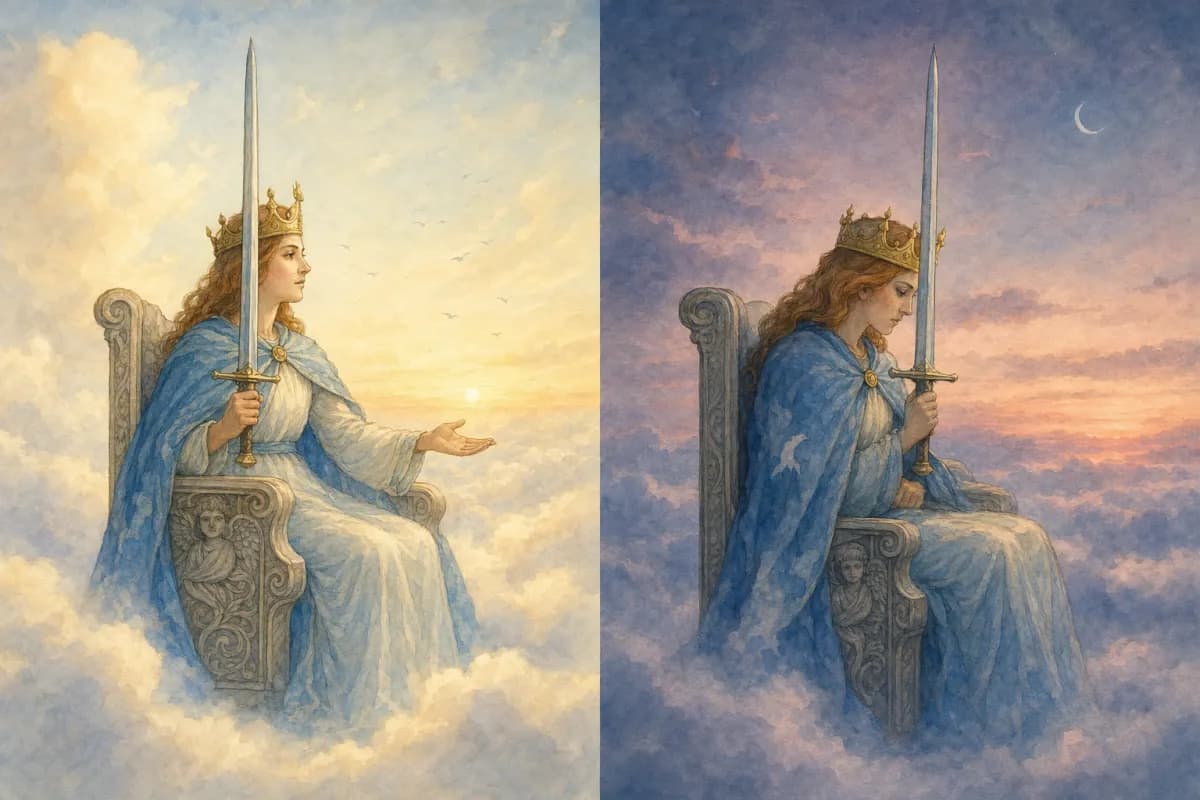
First, the question the suit forces me to answer plainly: is the reversed Queen of Swords negative? Usually, yes, more so than most court reversals. The upright Queen's gifts are unusually easy to turn into harm, and when she falls reversed I treat it as a genuine caution rather than a soft "blocked energy." But there are two very different shapes the reversal takes, and they are nearly opposite, so lumping them together is the standard mistake.
Core Reversed Keywords
- Coldness — Clarity frozen into distance
- Harsh criticism — Truth weaponised, the blade turned on people
- Bitterness — Old loss never grieved, hardened into resentment
- Manipulation — Sharp perception used to control rather than to clarify
- Emotional overwhelm — The opposite failure: feeling flooding her judgment
In-Depth Reversed Interpretation
The first and most common reversed reading is the bitter blade. The loss that upright wisdom grew from never got grieved; the Queen climbed above the clouds and refused to come back down, and the elevation she once used for clear sight has become a fortress. This is the woman whose honesty has curdled into cruelty, who uses her formidable read on people to find the soft spot and press it, who confuses "I am being real" with "I am allowed to wound you." Her sharpness has stopped serving truth and started serving the hurt she never processed. The Moon or the Five of Swords nearby pushes this toward something deliberate, and the card asks whether the truth being told is meant to fix or to punish.
The second reversed shape is the one popular guides barely mention, the inversion of everything she stands for: emotion drowning the clarity. Instead of thinking too coldly, she is feeling too much to think at all. The judgment she is famous for goes underwater, leaving her reactive, defensive, talking herself into stories the evidence does not support. I see this most in anxiety spreads, where a normally clear-headed person has lost the thread. It is the Queen knocked off her throne by feeling she usually governs.
To tell them apart live, I watch which direction the harm runs: frozen bitterness aims outward, at whoever is nearest, while emotional overwhelm collapses inward. A third tell is worth naming: the manipulation reading, where sharp perception becomes a tool for control rather than a flashlight for truth, the rarest shape and the one to take most seriously. If you cannot tell whether the person is being cold or cruel, that uncertainty is itself the reading, the same diagnostic the Queen of Swords as feelings page works through for the narrow question of romance.
Is the Sharpness Wisdom, or a Wound Still Bleeding?
This is the blind spot in nearly every Queen of Swords guide I have read, and the most useful thing the card can teach you. Other guides describe her as the wise truth-teller upright and the cutting woman reversed, as if those sat on clean opposite sides of a line. In real readings they do not. From the outside, the woman whose sharpness comes from healed wisdom and the one whose sharpness comes from an open wound look almost identical: same blunt sentence, same level gaze, same refusal to soften. So how do you read which one you are facing?
You stop listening to how sharp she is and start listening to what the sharpness is for.
Wisdom-sharpness serves the other person. The truth she tells leaves you more able to act, not smaller, and it comes with a door: here is what is wrong, here is what would help, I am telling you because you can handle it. It has been through grief and out the far side, which is why it stays honest without turning cruel. There is a Japanese word my teacher used for this bearing, 凛とした (rin to shita), a cool, upright dignity that is strong without being hard. Wound-sharpness serves the wound instead. The truth leaves you smaller, and that is the point, because shrinking you is how the unhealed hurt protects itself. It comes with no door, only a verdict, never grieved but frozen, and frozen things cut without warmth: 冷たい (tsumetai), cold in the way that shuts a door.
So the practical move, whether the card describes a person or describes you: do not measure how blunt the honesty is, measure what it leaves behind. If you are holding the blade, the test is the same: after you said the true hard thing, did the other person have somewhere to go?
Queen of Swords in Career & Communication
This is her home turf, where she is least controversial. Upright in a career reading, she is the senior figure whose authority comes from competence and candor: the manager who gives you the real feedback, the colleague who cuts through a stalled meeting with one accurate sentence, the advisor you trust because she has no reason to flatter you. If she describes you, your clarity and integrity are your professional capital, and people respect you even when they find you intimidating. Law, editing, medicine, research, any field that rewards seeing clearly and saying so precisely, clusters around this card.
Reversed in career splits the same two ways the whole reversal does: a boss whose criticism has turned corrosive, ruling by making people feel stupid, or you, either too cold to build the alliances you need or too rattled to think straight. The fix for the first is warmth; the fix for the second is altitude.
Queen of Swords in Love & Relationships
In love, the upright Queen is far warmer than her reputation, but the warmth is private and earned. She loves through honesty and loyalty rather than display: she tells you the truth others will not, chooses the hard conversation over quiet resentment, stays fiercely loyal once you are in. For singles, she can point to a person of this type, or a nudge to stop chasing and start vetting. The catch the whole card warns about: do not mistake her lack of gushing for a lack of feeling.
For the deeper version, the specific question of what it means when you have asked how someone actually feels about you, the Queen of Swords as feelings page goes further than I can here, including the crush and the no-contact ex.
Reversed in love is where you slow down. It can be a partner whose honesty has gone cold, using sharp accuracy to win arguments rather than to get closer; bitterness from an old relationship poisoning the new one; or you, so braced against being hurt again that you cannot let warmth in. Upright, the boundary keeps the relationship honest. Reversed, it keeps the relationship out.
Queen of Swords in Healing & Personal Truth
I read this position more than the old guides suggest, because the Queen's whole subject is what we do with pain after it lands. Upright here is a healthy sign: you have processed something hard and come out clearer, the card of having done the grieving and kept the lesson. Reversed is the warning that you skipped the grieving and kept only the armour, the numbness you call maturity, the boundary that is really a hiding place. The clarity is worth keeping; the coldness is the part costing you.
Queen of Swords Card Combinations
Queen of Swords + The Moon
Clarity meeting fog, and it cuts two ways. As advice it is strong: the Queen is exactly the energy that sees through The Moon's illusion. As a description of a person, it is a flag, sharp honesty on the surface with something murky underneath, the manipulation reading getting louder. When a client draws this about someone "brutally honest," I slow them down to check which one is true.
Queen of Swords + Justice
Two Air-aligned truth cards stacking into uncompromising fairness: a decision made on the merits, a situation where the facts will out, often a literal legal matter where impartial judgment wins. If you are asking, rule on the evidence, not on who you wish were right.
Queen of Swords + Three of Swords
The widow's card meeting heartbreak's card, the clearest picture of where her sharpness comes from: a real wound, fully felt. Upright, someone who has grieved and grown clear. Reversed Queen here is the one who froze instead of healing, bitterness that never got to be sadness first.
Queen of Swords + Ten of Cups
A hopeful collision: the most clear-eyed court card meeting the deck's image of a happy home. Often someone whose hard-won clarity finally lets them build something warm, the guarded heart that has decided a particular person is safe.
Queen of Swords Reversed + Five of Swords
The caution, confirmed. The Five of Swords is winning at the cost of the relationship, and the reversed Queen beside it is honesty turned into the weapon that does it. Read it as truth used to wound rather than mend, or a warning that you are about to win an argument and lose the person.
Numerology & Astrological Correspondences
The court cards are not numbered like the pips, so there is no digit to reduce. Her rank is the meaning: among the four Swords court figures she is the mature, governing feminine expression of Air, intellect seasoned by experience rather than merely sharpened.
Astrologically she carries Air in its receptive, governing mode, read most often across Libra, Aquarius, and Gemini. Many readers lean Libra for the balanced judgment or Aquarius for the cool detachment: the Libra thread explains her fairness, the Aquarian thread the emotional distance that can tip into reversed coldness. As a person she describes someone with strong Air placements, quick-minded, principled, articulate, and either bracingly clear or bracingly cold depending on which way the card fell and whether her grief was ever allowed to be grief.
Frequently Asked Questions
What does the Queen of Swords mean in tarot?
She means clear-eyed honesty, independence, and hard-won wisdom. Upright, she is a perceptive, principled figure who thinks before she feels, tells the truth even when it is uncomfortable, holds firm boundaries, and will not flatter you, usually someone who has been through loss and grown clearer for it. Reversed, those gifts sour into coldness, harsh criticism, bitterness, or manipulation, often driven by pain she never grieved.
Is the Queen of Swords a yes or no card?
Upright, a measured yes, arrived at by clear thinking rather than hope, so read it as "yes, and it will hold up to scrutiny." It favours decisions and matters needing a level head. Reversed shifts toward no, usually because the situation is clouded by old hurt or judgment gone cold rather than because the goal is wrong.
Who is the Queen of Swords as a person?
A mature, intelligent, independent figure, often older or simply seasoned, frequently someone who has known real loss and come out clearer rather than crushed. She is the honest friend, the no-nonsense mentor, the partner who tells you the truth others avoid. People find her intimidating until they earn their way past the guard to the loyalty underneath. Reversed, the same person reads as cold or bitter.
What zodiac sign is the Queen of Swords?
She is an Air card, read most often across Libra, Aquarius, and Gemini, with many readers leaning Libra for her fairness or Aquarius for her cool detachment. As a person she describes someone with prominent Air-sign energy: quick-thinking, articulate, principled, at home in the world of ideas.
What does the Queen of Swords reversed mean?
Two nearly opposite things. The first is coldness and bitterness: clarity frozen into a weapon, honesty used to wound, old loss that hardened instead of healing, sometimes tipping into manipulation. The second is the inversion, emotion flooding the judgment she is known for, leaving her defensive and reactive. Frozen bitterness aims outward; emotional overwhelm collapses inward. The surrounding cards tell you which.
Why does the Queen of Swords feel so cold?
Because her warmth is private and her honesty is public, so the part you meet first is the blade, not the tenderness behind it. The cherub carved into her throne is the clue: the softness is there, shown only to people who have earned trust. Genuine coldness belongs to the reversed card; upright, what looks cold is usually just a refusal to lie to you.
How is the Queen of Swords different from the King of Swords?
Both are mature Air authorities who lead with the mind, but the Queen's clarity is inward and discerning while the King's is outward and structural. She reads people with intuitive precision, often from hard personal experience; he applies principle and logic to govern. Neither is warmer; they wield the same Air differently.
Closing
The Queen of Swords is the deck's most underestimated court card, because the thing that makes her hard to love at first glance, her refusal to soften the truth, is the same thing that makes her worth trusting. She climbed above the fog to see clearly, and the only real question is whether she remembers what the fog felt like.
If you have drawn her, find the honest, sharp thing in your reading, your words or someone else's, and ask what it leaves behind. If the truth made the situation clearer and left a door open to do better, her sword is a gift. If it only made someone smaller and closed the conversation, the blade has turned on the wrong target. Then say the true thing anyway, the way she would, with the door left open.
Continue with the Air court: read the Queen of Swords as feelings for what it means when you have asked how someone feels about you, or plan a full reading with our love tarot spread guide.