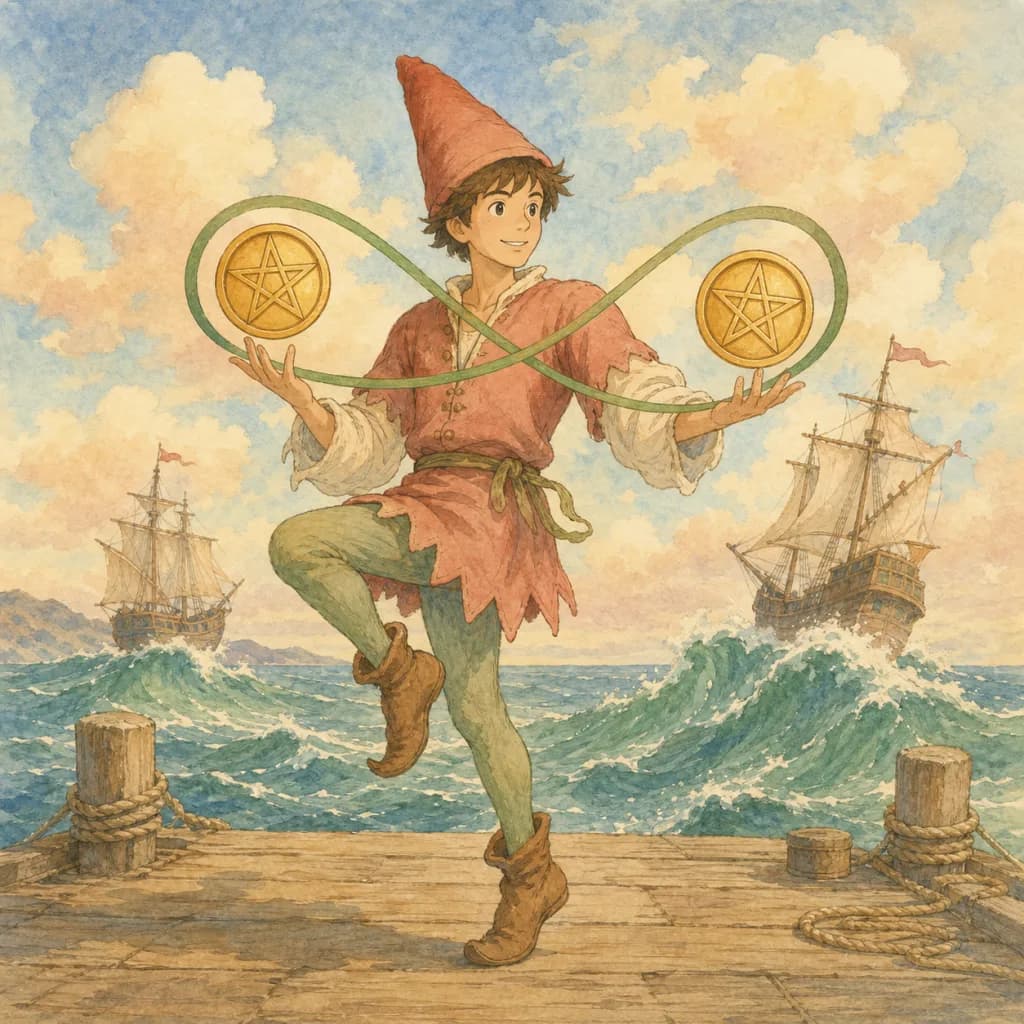
A young man stands on a wharf juggling two coins, and the strange thing is that he is dancing while he does it. One foot lifts off the ground. His knee bends mid-step. His whole body is moving, almost performing, with none of the bracing you would expect from someone afraid of dropping something. The Two of Pentacles meaning gets reduced to "work-life balance" so reliably that hardly anyone asks the obvious question: if this card is about balance, why is the figure refusing to stand still?
Behind him, two ships ride waves tall enough to bury them. He has his back half-turned to the sea, and his attention stays on the coins. He keeps time with the storm, letting its rhythm set his.
Quick Answer
Upright, the Two of Pentacles means balancing several priorities at once through adaptability, good timing, and a light touch — managing money, roles, or commitments that keep shifting in weight. Reversed, it means the juggle has tipped into overwhelm: dropped commitments, disorganization, financial strain, or pouring everything into one thing while the rest falls. As a Yes/No card it is a soft maybe that leans yes if you stay flexible, because the card rewards motion and adaptability above all.
Basic Information
| Card Name | Two of Pentacles |
| Suit | Pentacles |
| Arcana | Minor Arcana |
| Element | Earth |
| Astrological Correspondence | Jupiter in Capricorn |
| Yes / No | Maybe — leans yes if you stay adaptable |
| Upright Keywords | balance, adaptability, time management, juggling priorities, flexibility |
| Reversed Keywords | overwhelm, disorganization, dropped commitments, financial strain |
Card Imagery & Symbolism
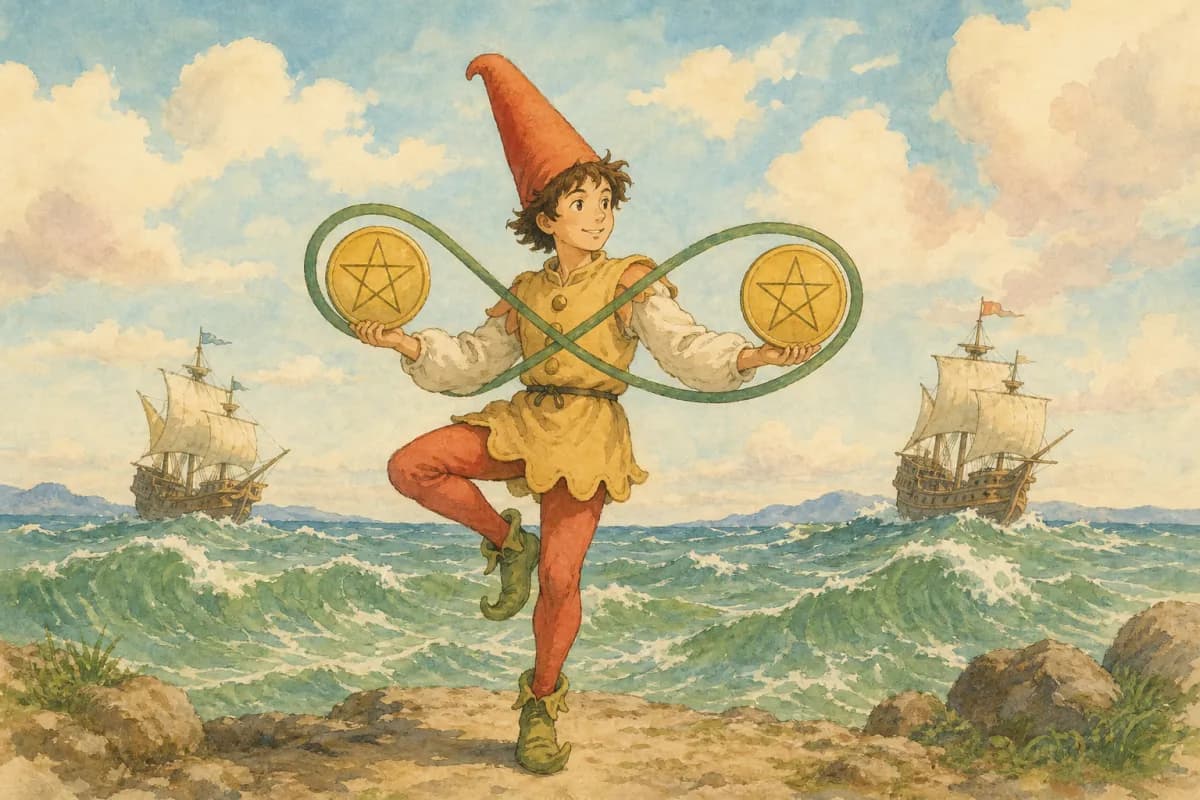
Pull up the Rider-Waite-Smith image and the first impression is almost comic: a man in a tall, pointed hat, knees flexed, tossing two coins like a street entertainer. Pamela Colman Smith gave a card about money and responsibility the body language of a juggler at a fair. That choice is the whole argument of the card, and most guides walk right past it. The serious material — earnings, schedules, obligations — is being handled by someone treating it as a game he can win only by staying loose.
The Two Coins Are Bound in a Lemniscate, Not Held Apart
The coins do not float independently. A green band loops around both in a figure-eight, the lemniscate — the same infinity sign that hovers over the Magician's head. Here is the detail people skip: the loop means the two coins work as one system. He is running a single continuous circuit, and the energy passes from one coin to the other and back. That is why he can manage two — they are linked, so a push on one becomes a lift on the other. What the card shows is a loop in perpetual transfer, a skill all its own.
He Is Dancing, Not Standing Firm
Look at the legs. One foot is planted, the other is raised, the weight shifted onto a bent knee. A skilled juggler never works from a wide, locked stance — he keeps his feet moving so his hands stay free. Smith drew the posture of someone whose stability lives in his motion, the way a cyclist stays upright only by rolling forward. Compare this to the Four of Pentacles, where a man sits rigid and clutches his coins, perfectly still and perfectly stuck. The Two stays in motion on purpose. Stop moving and the whole act collapses. The dance is doing the real work here; it is the mechanism that keeps the coins aloft.
Two Ships Ride High on Rough Water
Behind the figure, two ships rise and fall on enormous green swells. Most readings file this under "the ups and downs of life are manageable." True, but thin. Notice how the ships ride the waves: their hulls lift with each crest, giving with the water as it rolls under them. A ship that stays rigid in a heavy sea gets swamped. The one that rolls with each swell rides it out and keeps sailing. Smith placed the sea behind the juggler as a mirror of his own body, both of them surviving by moving with the force. The waves describe the medium you are working in, and calm seas were never part of the promise.
Two of Pentacles Upright Meaning
Core keywords: balance, adaptability, time management, juggling priorities, flexibility.
Upright, this card lands when you are managing more than one demand at once and somehow keeping all of it moving. The classic picture is work and home, but it shows up for anyone running parallel tracks: two jobs, a job and a side project, a budget split across debts, a week where three people all need you on the same afternoon. The Two of Pentacles confirms you are coping, and coping with a certain grace — you are reading the situation, shifting weight, adjusting in real time.
What makes it specifically a Pentacles two is that the balancing stays practical and ongoing, rooted in the stuff of daily life — coins, hours, and obligations you can count. This is earth-suit work: money, time, energy, the physical hours in a day. The equilibrium it describes is thoroughly practical — the daily act of deciding what gets your attention this hour and what waits.
The quiet warning lives inside the praise. The card tells you the act is working, and it tells you the margin is thin. A juggler who is doing well is still one distraction away from a dropped coin. Upright reports that you currently have the skill to keep the balance going — a snapshot of this moment, carrying no guarantee about next month.
So the upright posture is simple: keep adjusting, and do not mistake the smoothness for permanence. The moment you decide you have it handled and stop watching is the moment one coin hits the ground.
Two of Pentacles Reversed Meaning
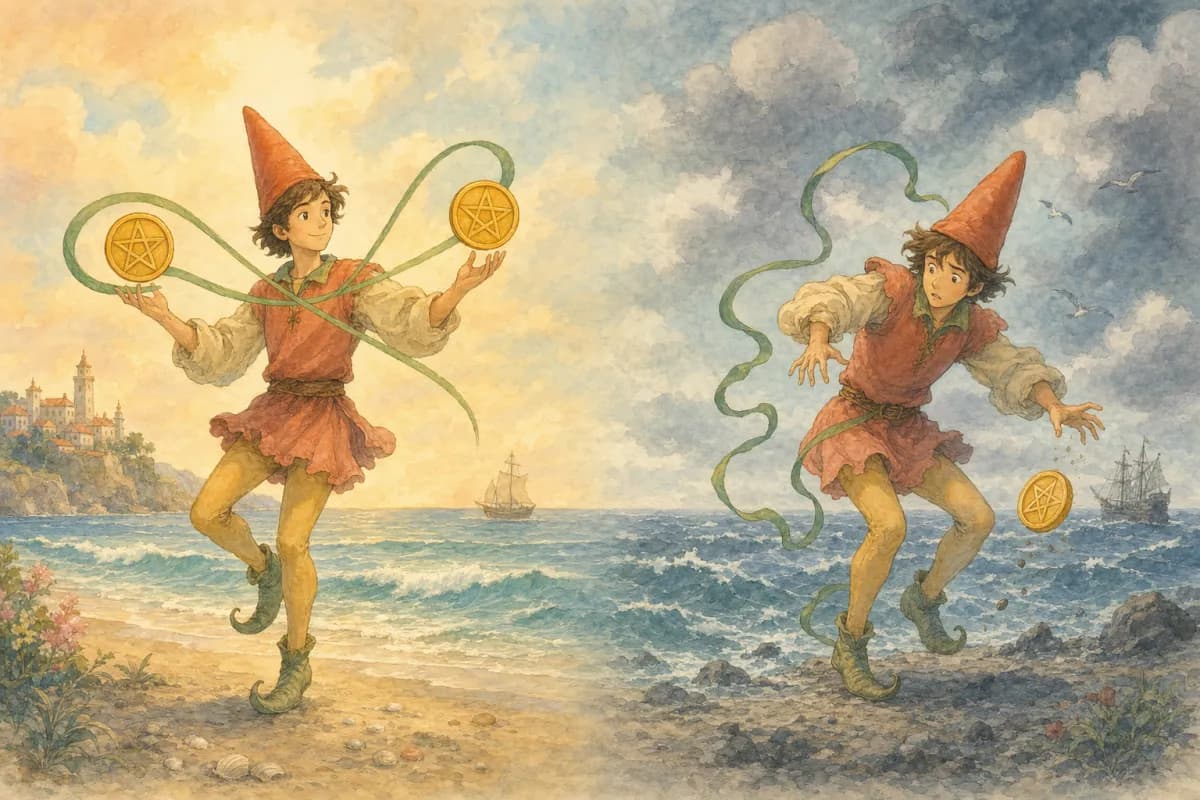
First, plainly: I slow clients down when they read the reversed Two of Pentacles as a catastrophe card. In most readings it signals something gentler — the juggle has simply gotten heavier than the juggler, and something has to give before it gives on its own.
There are a few shapes this takes. The most common is overwhelm — too many balls in the air, and the flexibility that made the upright card work has curdled into frantic scrambling. The adapting has given way to pure reaction, putting out whichever fire is loudest. The second is disorganization — the loop has broken down, leaving a pile of unconnected tasks where one smooth circuit used to run: bills you forgot, a calendar you have lost track of. The third is dropped commitments — you have started saying yes to keep the peace and then quietly failing to deliver, and that broken follow-through quietly drains the trust an honest no would have protected. And there is financial strain, the literal pentacles reading: income and outgoings no longer move in a workable rhythm, and you are robbing one account to feed another.
The fix changes with the shape. Overwhelm asks you to take something off the list, since juggling faster only speeds the crash. Disorganization asks for a system, when willpower alone has already failed. Dropped commitments ask you to renegotiate honestly. Financial strain asks for a hard look at the numbers. The reversed card hands you a diagnosis, pointing at which kind of too-much you are carrying.
The waves behind the juggler: why balance here is a motion, never a resting state?
This is the question most guides circle but never land on. They all mention the ships and the rough sea, and they tend to read it as reassurance — "the ups and downs are survivable." Few stop to ask why a card about balance would put a storm in the background at all, when calm water would seem to make the point better.
Go back to the waves. If the Two of Pentacles were really about reaching equilibrium, the honest image would be flat sea and a man standing still with two coins resting in his palms. Smith drew heavy swells and a figure who cannot stop dancing. The picture argues that the balance this card describes is something you do, continuously, for as long as the situation lasts — an activity, with no final state to arrive at and keep.
This is the single most useful reframe I can offer for this card, and it is the one almost nobody teaches. Most people who pull the Two of Pentacles are exhausted, and they read it as a promise: keep going and you will eventually reach steady ground. The card is telling them the steady ground stays out of reach, and the reason is pure circumstance. They have done nothing wrong; the waves are simply the conditions they are working in. Picture a parent of small children, a freelancer with three clients, anyone mid-career with aging parents: for them the sea stays choppy for years. The skill being asked for is riding it with loose, easy knees.
I sat with this for a long time before I trusted it. For years I read the Two as a transitional card, a rough patch on the way to something settled, and I told clients the storm would pass. Some of them came back months later still in the storm, feeling like they had failed the card. The failure was mine — I had misread it. The waves are the water this particular life is sailing in, and the card's actual gift is the posture for it: feet moving, knees soft, weight transferring, attention on the loop while the imagined shore stays out of view.
There is a freedom in that, once it lands. Treat balance as a destination and every day short of it feels like falling behind. Treat it as a motion and a kinder question takes over: am I moving well right now? The juggler keeps dancing to the music while the sea keeps rolling under him, and neither one is waiting for it to stop.
Career & Money
This is the Two of Pentacles on home ground. In a work spread it points to managing competing demands — two projects, a job and a job hunt, a role that keeps shifting under you. The card reads the situation as workable as long as you stay nimble. The danger is the over-rigid response: trying to impose a fixed schedule on a fluid week and then feeling like a failure when the week refuses to hold the shape.
On money specifically, this is one of the most literal cards in the deck. It shows up for people moving funds between accounts, balancing income against outgoings, deciding between two purchases, or carrying debt across cards. The reading is silent on whether you are broke or rich. Its one message is that your money is in motion and needs active steering. Reversed, that steering has slipped — bills missed, a budget that no longer reflects reality, the strain of robbing Peter to pay Paul one month too many.
A note from years of reading professionals in Tokyo: this card appears constantly for people deciding whether to leave a secure job for a riskier one. A client in Setagaya pulled it three readings running while weighing a stable corporate role against a startup offer. Each time, the card showed her that she was already living in the in-between — already juggling the comfort of one role and the pull of the other — and that the discomfort she felt was the honest weight of holding two real options at once. The Two leaves the choice unresolved and dignifies how hard it is to carry.
Personal Energy & Time
Stripped of money and career, the Two of Pentacles is a card about how you spend your hours and your attention. It reads as a stretch where you are split across too many roles and trying to give each one enough — the person who is a worker by day, a caregiver by evening, a friend on the weekend, and never quite all-present in any of them.
The upright energy here is genuine competence under load. You are managing, and there is something to respect in that. The caution is that the body keeps a tally the calendar does not. A relentless juggle that looks smooth from the outside can be quietly draining the person doing it. Reversed, that drain has come due — the overwhelm is no longer just a feeling, it is showing up as missed sleep, snapped patience, things slipping. The card's advice in this domain usually comes down to one line: "drop a coin on purpose, before one falls by accident."
Two of Pentacles Card Combinations
- Two of Pentacles + The Magician — the lemniscate appears on both cards, so this pairing doubles down on the loop. It reads as juggling with real skill: you have the tools and the focus to keep multiple things in the air, and you are doing it deliberately, in full command of the act. A strong signal for someone running several projects who actually has the competence to pull it off.
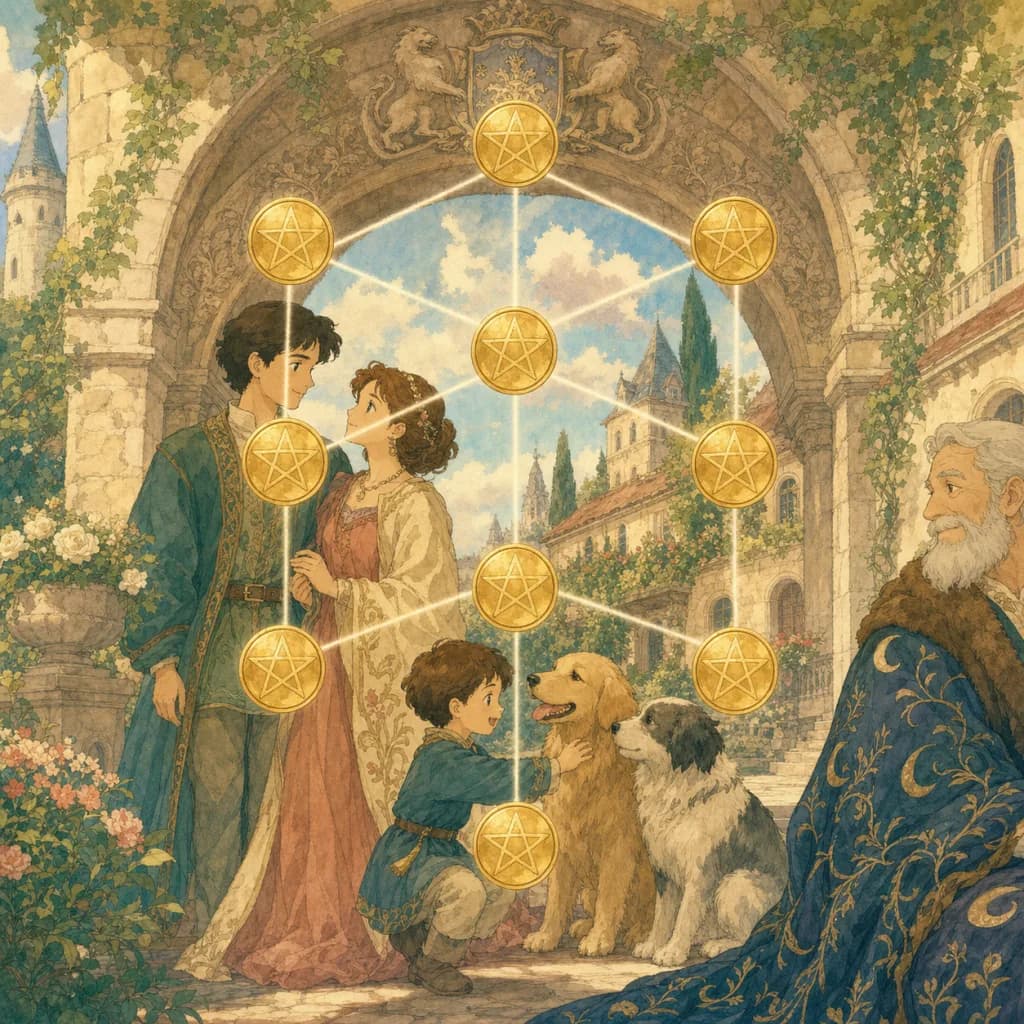
- Two of Pentacles + Ten of Pentacles — present juggle next to future stability. This is the rare combination where the steady ground really is in view: the financial balancing act now is building toward lasting security later. Read it as confirmation that the current motion has a destination, even if today still feels like all swells and no shore.
- Two of Pentacles + The Tower — the juggle hits a sudden disruption it cannot absorb. One coin gets knocked clean out of the air by something outside your control. Often a forced reckoning: an expense, a job loss, a demand that breaks the careful system. Not a punishment, but a sign the old balancing act will not survive intact and a new arrangement is coming whether you plan it or not.
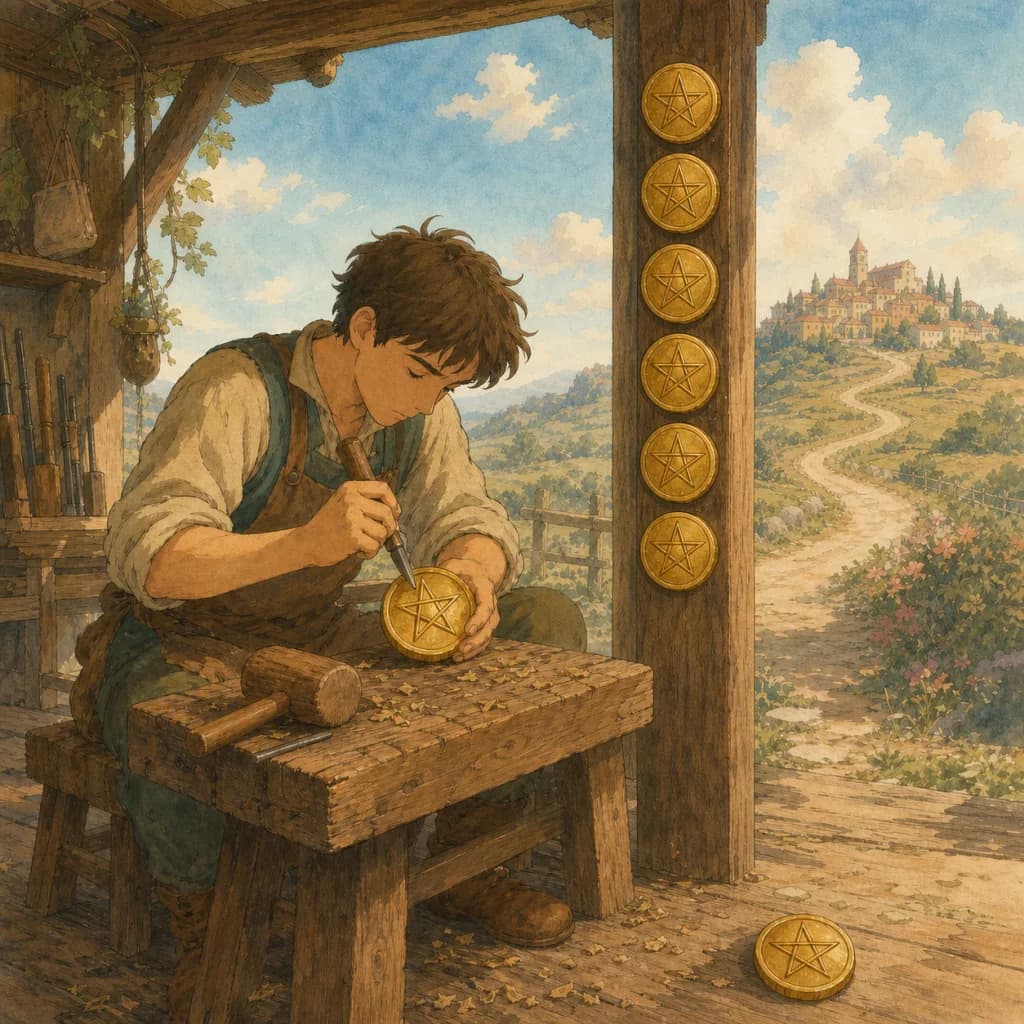
- Two of Pentacles + Four of Pentacles — motion meets clenching. These two are opposites of the same suit: the dancer and the man who sits rigid clutching his coins. Together they often flag the tension in a money situation — part of you wants to keep things fluid and responsive, part of you wants to lock it all down and stop the flow. The reading lives in which impulse is serving you.
- Two of Pentacles reversed + Ten of Wands — overwhelm stacked on overload. The juggle has collapsed and you are now simply hauling too much, head down, no grace left in it. This pairing is the deck being blunt: the problem is not your technique, it is the sheer volume. Something comes off the pile, or you go down under it.
Numerology & Astrological Correspondences
As a two, the card marks the first practical balancing of resources in the Pentacles line — the single seed of the Ace of Pentacles becomes two demands that now have to be held together. Its astrological assignment is Jupiter in Capricorn: Jupiter's expansion squeezed into Capricorn's discipline, which is exactly the card's tension — more to handle, and a structure asking you to handle it well. The Japanese teachers I trained under read this card through the image of tightrope-walking, the specific poise of someone crossing on a wire, where the body has to keep adjusting the whole way across. That framing has stayed with me because it treats the balance as something you perform across a distance you eventually finish — a crossing, a stretch of wire with solid ground waiting at the far end.
Frequently Asked Questions
What does the Two of Pentacles mean in a reading?
It means you are balancing multiple priorities — usually money, time, or competing responsibilities — and currently managing them through adaptability and good timing. The card confirms you are coping, with a quiet reminder that the balance needs active attention to hold. It rewards flexibility and good timing.
Is the Two of Pentacles a yes or no card?
It is closer to a maybe that leans yes, on the condition that you stay adaptable. The card describes the work of managing an ongoing situation, so it withholds any clean, final outcome. If your question needs flexibility and timing, read it as a cautious yes; if it needs rock-solid certainty, the answer is "not yet."
What does the Two of Pentacles mean in love?
In a relationship reading it often means you are struggling to make time for your partner because work, money, or family demands are pulling your attention away. For singles it can point to juggling two interests, or being too stretched to make romance a priority right now. The card asks whether the relationship is getting its share of the juggle or quietly slipping to the bottom of the list.
What does the Two of Pentacles reversed mean?
Reversed, the balancing act has tipped into overwhelm, disorganization, dropped commitments, or financial strain. You are juggling more than you can hold, or pouring everything into one area while the rest falls. Read it as an invitation to take something off the list or build a real system, with no need to abandon everything at once.
What does the Two of Pentacles mean for money and finances?
It is one of the most literal money cards in the deck. It points to actively managing finances — moving funds between accounts, balancing income against outgoings, weighing two expenses, or carrying debt that needs steering. Upright the management is working; reversed it has slipped into strain.
Why is the figure on the Two of Pentacles dancing?
Because the card frames balance as a continuous motion. The juggler keeps his feet moving and his knees soft because that is the only way to keep two coins in a continuous loop; the moment he stands rigid, the act collapses. The dance is the card's actual lesson: stability here comes from staying responsive, from rolling with each shift as it arrives.
What zodiac sign and planet rule the Two of Pentacles?
It corresponds to Jupiter in Capricorn — specifically the first decan of Capricorn (0–9 degrees) in many systems. Jupiter's drive to expand inside Capricorn's earthy discipline mirrors the card's core tension: more to manage, and a steady structure asking you to manage it carefully.
Closing
The next time this card turns up, resist the urge to read it as a promise that the busy season will end. Instead, find the one commitment you are quietly failing to keep and either renegotiate it honestly or let it go on purpose. A coin you set down by choice costs you almost nothing. A coin that slips loose when your attention wanders takes a real toll. The juggler stopped waiting for calm water a long time ago, and so can you. Learn the dance.
Keep reading the suit's arc with the Three of Pentacles for where the juggle becomes collaboration, or see the rigid opposite of this card in the Four of Pentacles.