Most readers hand you the same line about the Four of Swords: rest, recharge, come back stronger. Good advice, and it's where almost every guide stops. What that summary skips is the harder question the card puts to you — whether the stillness you're in is a rest you chose or a shutdown you can't switch off. Those two look identical from the outside, and the Four of Swords is one of the few cards that makes you tell them apart. After more than a decade reading the Rider-Waite-Smith deck in Tokyo, this is the Swords card I most often watch people get half-right.
This guide goes past "put your sword down and nap." It reads the symbolism in detail — including the stained-glass window almost nobody mentions — covers the upright and reversed meanings plainly, and answers the questions clients ask.
Quick Answer
The Four of Swords means deliberate rest, recovery, and withdrawal after a period of strain — a pause to recuperate and let the mind go quiet before re-engaging. Upright, it points to healing solitude, convalescence, and stepping back to plan your next move. Reversed, it usually means you're emerging from that rest and returning to action, or you've put off rest so long that burnout is forcing the issue. Yes / No: it leans toward "not yet" — a pause before any clean verdict.
Basic Information
| Attribute | Details |
|---|---|
| Card Name | Four of Swords |
| Suit | Swords |
| Arcana | Minor Arcana |
| Element | Air |
| Astrological Correspondence | Jupiter in Libra |
| Yes / No | Not yet / wait (rest before deciding) |
| Upright Keywords | Rest, recovery, recuperation, meditation, retreat, convalescence, planning, solitude |
| Reversed Keywords | Re-engagement, awakening, restlessness, burnout, stagnation, avoidance, exhaustion |
Card Imagery & Symbolism
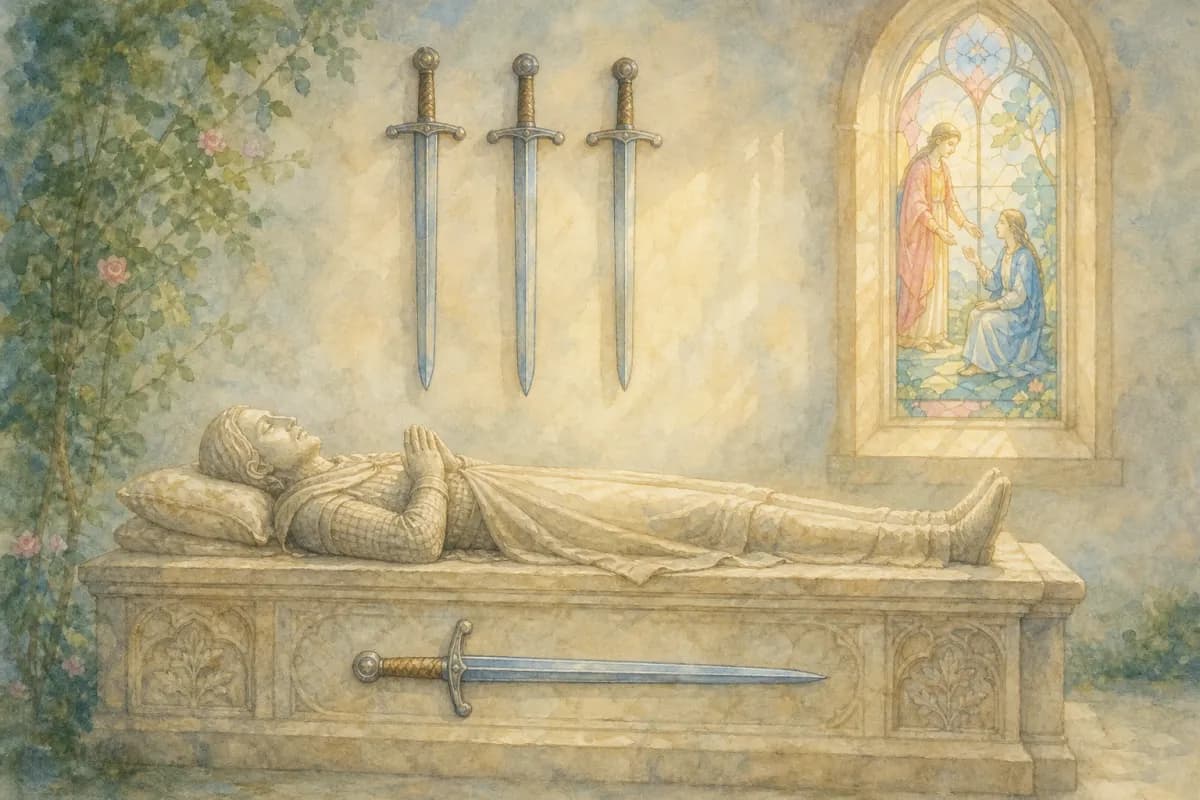
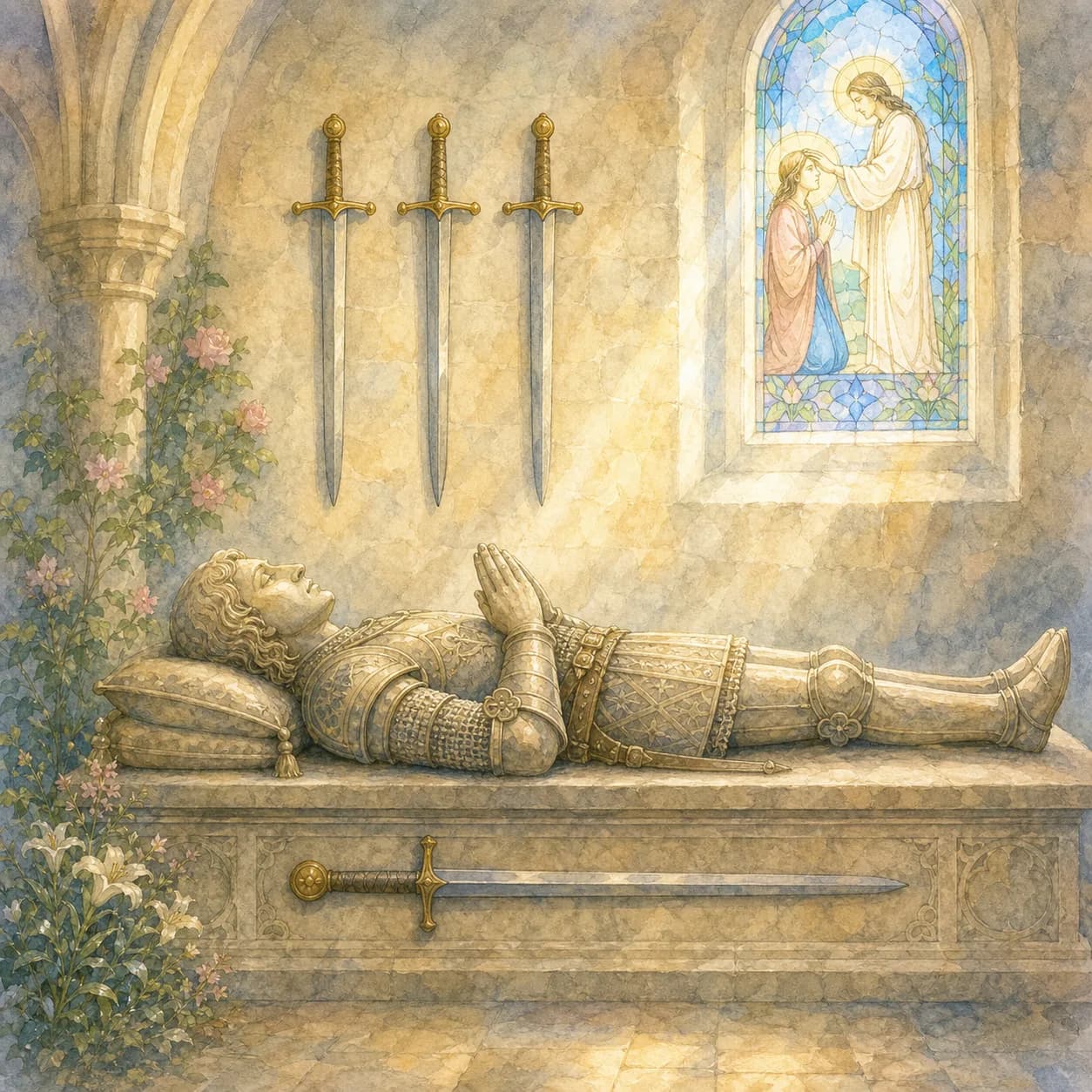
The scene is unusually quiet for the Swords suit, which is the whole point. A knight's effigy lies flat on a stone tomb inside what looks like a chapel, hands pressed together in prayer. Three swords hang on the wall above him, all pointing down toward his body; a fourth lies along the side of the tomb beneath him. High in the wall, a stained-glass window glows with a small scene: a figure approaching another, often read as a healer before a seated figure. Most guides list these objects; fewer notice that the card is a suit of mental conflict frozen mid-breath.
The Three Swords on the Wall — Hung Up and Set Down
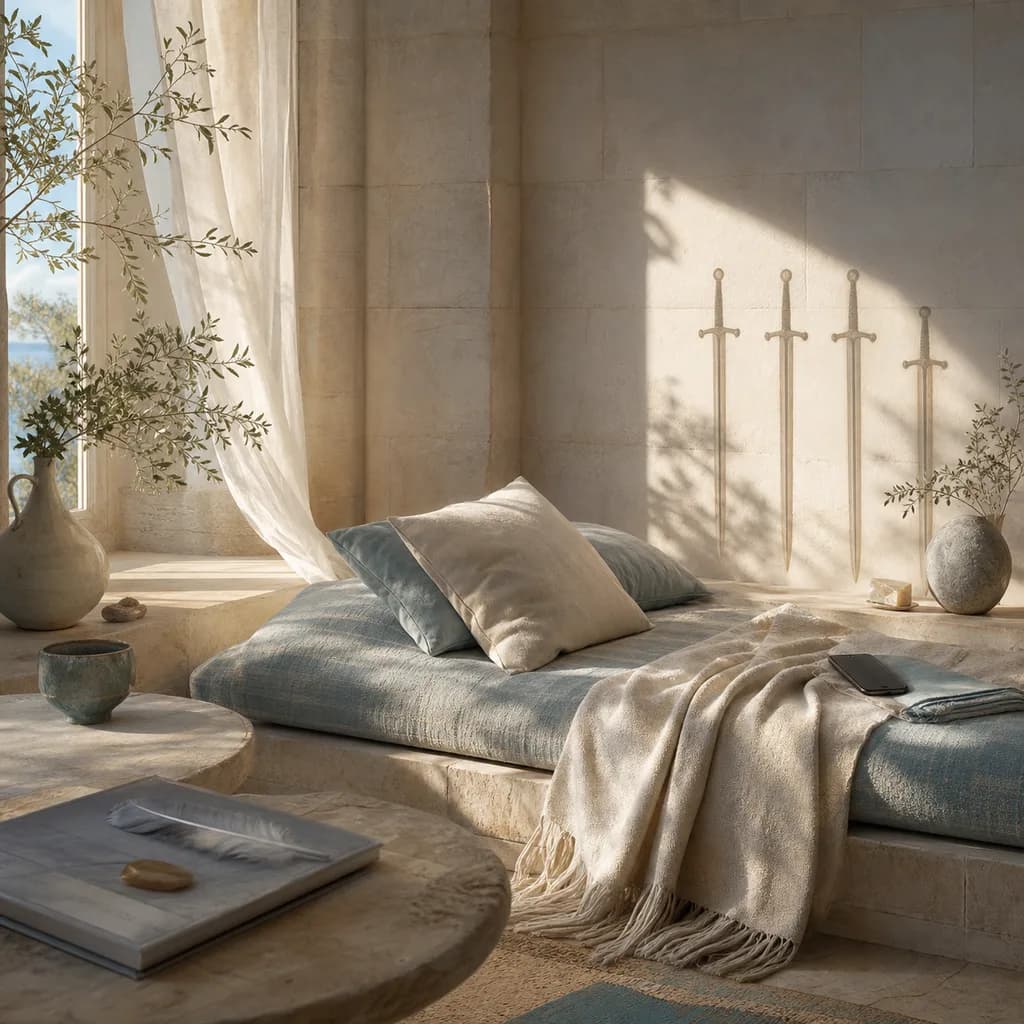
This is the detail that sets the card's temperature. In every other low pip of the suit, the swords are in play: clashing, piercing, balanced on edge. Here, three of them are mounted on the wall, out of reach of the sleeping figure. They have not vanished — the conflicts that came before still hang right over his head — but they have been set down. The knight has simply stopped picking them up. When a client tells me their mind won't stop running, I point at those three blades: the work of this card is hanging your worries on the wall for one night.
The Fourth Sword Beneath Him
The single sword along the base of the tomb is the one people misread as menace. It's the one weapon the knight keeps within arm's reach: he rests still armed, the fight only paused. The Four of Swords is a tactical retreat, and the figure intends to get up.
The Stained-Glass Window — the Detail Nobody Reads
Look at what the light is coming through. The window shows a small figure approaching a seated one, traditionally read as a scene of healing or blessing — the word "Pax," peace, is sometimes associated with this card. It's the most overlooked thing in the whole image, because it tells you what the rest is for. The knight lies in a room that opens onto something: a relationship, a world, a someone waiting on the other side of the glass. Every time I read this card for someone convinced they need to withdraw forever, I bring them back to the window — the rest is what makes reconnection possible.
The Posture of Prayer
The hands are folded in prayer over the chest — a recuperative, almost meditative stillness, closer to a vigil than a funeral. This is convalescence with intention. The Four of Swords treats rest as a practice, the way The Hermit treats solitude.
Four of Swords Upright Meaning
Upright, the Four of Swords is the deck's permission slip to stop. After the suffering of the Three of Swords, this is the field hospital where you recover before the next stretch of road.
Core Upright Keywords
- Rest and recovery — A deliberate pause to restore depleted energy
- Convalescence — Healing after illness, stress, grief, or conflict
- Meditation and solitude — Quiet chosen on purpose
- Regrouping — Stepping back to assess before acting
- Self-protection — Conserving resources for later
In-Depth Upright Interpretation
The most common reading I give for upright Four of Swords is the simplest: you are allowed to stop, and you probably need to. The card shows up when someone has been running on reserves — after a breakup, a brutal work quarter, a long season of caretaking — and the instruction is to lie down first.
There's a planning dimension people underrate. The figure is still, not unconscious, and that stillness is where strategy happens. The decision you can't make inside the noise of a situation becomes obvious from the quiet of the tomb. The card keeps the question alive and promises a better-rested answer.
A client in Tokyo, a nurse, drew this card three times in a month while asking whether to leave a job that was grinding her down. She wanted a verdict. I told her the card was refusing to answer yet, on purpose: the Four of Swords is the card you draw before the decision. She took ten days off, her first real leave in two years. The choice she made afterward — she stayed, then transferred departments — was one she could never have reached while exhausted. That's the card protecting a decision from being made by a depleted person.
The trap to avoid is reading the upright card as laziness. Rest here is active: it has a purpose and an end, and the figure keeps a sword within reach because he's coming back.
Four of Swords Reversed Meaning
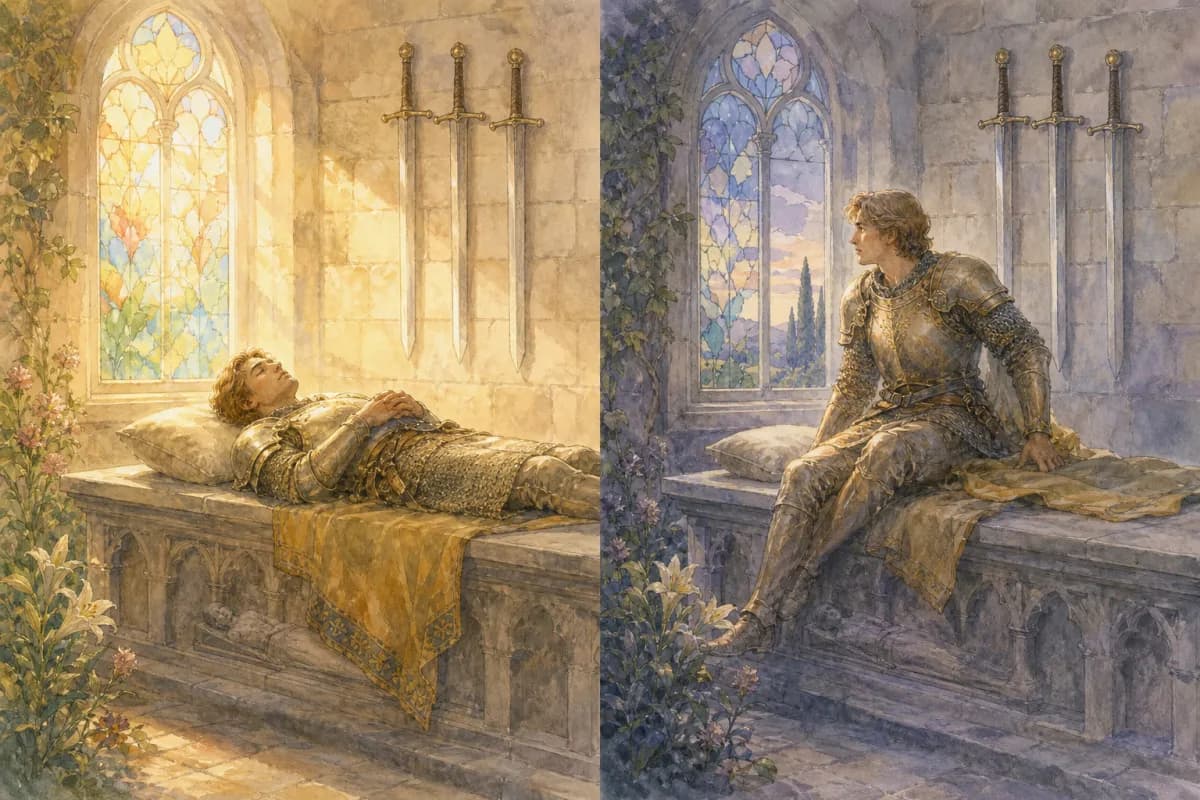
First, the question I always answer straight: is reversed Four of Swords negative? Not inherently — this is one reversal I'd call hopeful more often than not. The most common reading is the rest ending well: you're waking up, energy returning, ready to step back into the world. The negative versions exist, but they're the minority, and they're specific.
Core Reversed Keywords
- Re-engagement — Coming out of retreat, back into action
- Awakening — Mental clarity returning after a fog
- Restlessness — Inability to rest when you need to
- Burnout — Rest postponed so long the body forces it
- Stagnation — A pause that has overstayed into avoidance
In-Depth Reversed Interpretation
The first and most common reading is the upswing — you're surfacing. The rest has done its work. Whatever knocked you flat has loosened its grip, and the figure stirs, getting up off the tomb. When the surrounding cards are forward-moving, this is the reading I take.
The second is restlessness — you can't make yourself rest. Here the reversal flips the card's gift against itself. You know you need to stop, and you can't. The mind keeps barraging itself; sleep won't come; you fill every quiet hour because the quiet is unbearable. Insomnia shows up a lot. The card names the agitation and asks what you're avoiding by refusing to be still.
The third, and the one to watch, is burnout — rest deferred until it's no longer optional. This is the person who skipped the Four of Swords' invitation so many times that the body collapsed and made the choice for them. Here the card has stopped being advice and become a diagnosis. The reading I give is blunt: the rest is happening whether you schedule it or not, and the only choice left is whether you take it on purpose.
How do I tell these apart in a live reading? I look at where the energy is pointing. Surfacing has momentum toward the world; restlessness has momentum with nowhere to go; burnout has none at all. The neighbors confirm it — an Eight of Wands or The Star nearby pushes toward hopeful surfacing; The Tower or the Ten of Wands pushes toward collapse.
Is This Rest You're Choosing, or a Shutdown You Can't Stop?
This is the blind spot in nearly every Four of Swords guide I've read, and the most useful thing the card can teach. Most articles describe it as rest and leave it there, as if all stillness were the same. There is a world of difference between the rest you choose — close the laptop, take the leave, lie down on purpose — and the shutdown you can't escape: the depressive flatness, the freeze response, the numbness that masquerades as peace because nothing moves. The card's image is the same either way. So which one is it pointing at?
You stop reading the stillness and start reading whether it restores.
Chosen rest replenishes. You can feel the tank refilling, even slowly — a little more energy each day, the noise in the head dropping, the appetite for the world quietly returning. The window is doing its job: there's something to come back to, and a part of you that wants to. That's the healthy upright card, and the right move is to protect it.
A shutdown depletes even while you're "resting." The days bleed together, the lying-down gives no energy back, and the window has gone dark — you've stopped imagining a return at all. This is where I gently tell clients the cards have found the edge of what cards are for. If a fair stretch of genuine rest still leaves the tank empty, that's a sign to bring a person into it — a friend, a doctor, a professional. There's a healer in that window for a reason.
So here's the practical test: measure whether the stillness gives anything back. Real rest flows energy toward you. A shutdown only looks restful because nothing's moving in it.
Four of Swords in Love & Relationships
In love, the upright Four of Swords usually marks a pause, not a problem. One or both partners have pulled back to recover, and the relationship is catching its breath. The advice I give most often here is counterintuitive: do less. Pressing for reassurance during this card's season reads as another demand on an empty account; give the rest room and the warmth tends to return on its own. For singles, the card often means it isn't time to date yet — finish healing from the last one so the next connection gets your whole self.
Reversed in love is usually the better news: a relationship recovering, warmth flowing back, someone re-engaging after a withdrawal. The harder reading is when stress between two people spirals and the "space" becomes a distance neither knows how to close. For what someone actually feels when this card appears — whether their silence reads as rest or rejection — the Four of Swords as feelings page works through that diagnosis in more depth than I can here.
Four of Swords in Career & Work
This is the card's most literal territory. Upright in a career reading, the Four of Swords often means exactly what it depicts: take the leave, take the sick day, take the sabbatical. It shows up around recovery from work stress, returning after time off, or the period right before a big push when the smart move is to bank rest early. It can also signal a strategic pause — stepping out of a project just far enough to see its shape before committing to the next phase. Some of the best career decisions get made in the quiet this card protects, so resist reading a deliberate pause as falling behind; the figure planning his next move from the tomb is the truest picture of this card at work.
Reversed in career usually means getting back in the saddle, returning to work with energy restored. Its shadow is the burnout reading: someone working straight toward collapse. Next to stress cards, I read it as a warning to schedule the rest before the body schedules it for you.
Four of Swords in Health & Mental Recovery
Health is where this card speaks most directly. Upright, the Four of Swords is one of the deck's clearest convalescence cards — recovery after illness, the body asking for sleep, the nervous system needing quiet. It's a reassuring card to draw about health: healing is underway and rest is the medicine. For mental health, it points to the value of stillness, meditation, and stepping out of overstimulation.
The reversed card is where I pay closer attention: it can mean recovery finishing well, but it can also flag insomnia, anxiety that won't let the mind settle, or exhaustion tipping into something heavier. If the rest stops restoring, the card is pointing past itself toward real-world support.
Four of Swords Card Combinations
Four of Swords + The Star
Healing that's actually working. The Four gives the rest; The Star gives the renewal on the other side of it. When these two land together I read the recovery as genuine — the tank is refilling and the window is bright. Common after someone comes through a hard season and begins to feel like themselves again.
Four of Swords + The Tower
Rest cut short by upheaval, or rest desperately needed after one. Order matters: Tower-then-Four reads as recovery after a shock; Four-then-Tower, as a peace about to be interrupted.
Four of Swords + Three of Swords
The suit's own sequence — heartbreak followed by recuperation. The Three is the injury, the Four the healing already beginning. A more hopeful pairing than it looks, because the worst has passed and the rest has started.
Four of Swords + Five of Swords
Reading the suit forward, the rest of the Four often gives way to the Five of Swords — the conflict that flares once you're back on your feet. Drawn together, they ask whether you've actually recovered or just re-entered the fight too soon.
Four of Swords + Six of Swords
Rest before the crossing. The Four restores you; the Six of Swords is the quiet passage to calmer water that the recovery makes possible. A gentle, forward-moving pairing — you heal, then you leave for somewhere better.
Four of Swords + Eight of Cups
Rest before a departure. The Four pauses; the Eight gets up and walks away from something no longer worth staying for. Together they often mean someone gathering strength for a leaving already decided on.
Four of Swords + Nine of Wands
The rest the over-guarding Nine of Wands keeps refusing. The Nine stands braced and scarred, sure the next blow is coming; the Four beside it is permission to finally lower the guard and lie down. Together they read as a body that has earned a break it won't let itself take.
Four of Swords + Ten of Wands
The burnout flag in capital letters. The Ten of Wands is the person carrying far too much; the Four of Swords beside it is the body demanding the rest the mind keeps refusing. The reading is almost always "stop before you're stopped."
Numerology & Astrological Correspondences
The fours of the tarot are all about consolidation — the moment a suit stops expanding and builds a structure to hold what the threes produced. In Swords, the suit of mind and conflict, that consolidation is unusual, because you can't build a wall out of arguments. So the Four of Swords consolidates by stopping — it holds the mental energy still long enough to recover. Where the Four of Pentacles hoards and the Four of Cups withdraws into apathy, this one builds its structure out of stillness itself. The pause is the foundation.
Astrologically, the card carries Jupiter in Libra. Jupiter's expansiveness in Libra's airy, balance-seeking sign reads as the wisdom to know when to stop — equilibrium recovered after the scales tipped too far. It's a gentler signature than most of the Swords suit, which fits: this is the one low Swords card that isn't trying to cut anything.
In Japanese タロット占い, the Four of Swords is often read through 「英気を養う」(eiki o yashinau) — to nourish your vital energy before the next effort. A teacher of mine framed it as 「休むのも仕事のうち」: resting is part of the work, too. That framing is kinder than the English instinct to treat any pause as falling behind, and closer to what the card depicts — disciplined recovery.
Frequently Asked Questions
What does the Four of Swords mean?
It means deliberate rest and recovery after a period of strain — a pause to recuperate and quiet the mind before re-engaging. Upright, it's healing solitude and stepping back to plan. Reversed, it's usually emerging from that rest back into action, or being forced to rest because burnout has caught up. At its core it's restoration that prepares you to return.
Is the Four of Swords a yes or no card?
It leans toward "not yet." The card's whole nature is the pause before a decision, so it rarely gives a clean yes or no — it asks you to rest first and decide once you're not depleted. Upright reads as "wait"; reversed leans slightly toward yes as your energy returns.
What does the Four of Swords mean in love?
Upright, it usually signals a pause for recovery — one or both partners pulling back while the strain eases. For singles it often means healing before dating again. Reversed is generally more hopeful: a relationship recovering, warmth returning, someone re-engaging after a withdrawal.
What does the Four of Swords reversed mean?
Three main things. Most often, you're surfacing from rest and returning to action — a hopeful reading. Sometimes it's restlessness, the inability to rest even when you need to. At its hardest, it's burnout: rest postponed until the body forces it. The surrounding cards tell you which one you're facing.
Does the Four of Swords mean rest?
Yes — it's the clearest rest-and-recovery card in the Swords suit. But the more useful question is what kind of rest. The card distinguishes chosen, restorative rest (which refills your energy) from a shutdown that depletes even while you lie still. If the stillness gives nothing back, the card is pointing you toward real support beyond more rest.
How is the Four of Swords different from The Hermit?
The Four of Swords is recovery — rest after something depleted you. The Hermit is retreat chosen deliberately, an active search for wisdom. The Four heals what's been spent; The Hermit goes looking for what hasn't yet been found. When both appear, someone usually needs the Four's rest before they can do the Hermit's work.
Can the Four of Swords indicate illness?
It can, but usually it points to recovery over crisis — convalescence, the body asking for sleep, healing already underway. It's a reassuring card to draw about health. Reversed, watch for burnout, insomnia, or exhaustion tipping into something heavier, in which case the card points toward rest and professional support.
Closing
The Four of Swords is the deck's quietest mercy. It gives you permission to hang the sword on the wall and lie down for a while, and asks in return that you treat the pause as preparation: the stillness on the tomb is where the next move gets planned, and the window is the reminder that there's something to plan toward.
If you've drawn it, here's the concrete move this week. Take one genuine, uninterrupted day of rest — no laptop, no decisions, no fixing anything — then look at the decision you've been carrying. The strategy you couldn't reach inside the noise tends to surface in the quiet, and the figure keeps a sword within reach because he means to get up and use it.
Continue exploring the Swords suit: read the Four of Swords as feelings for what someone's silence means when you've asked how they feel, or compare The Hermit for deliberately chosen solitude.